AI Lead Finder
 Email Finder
 Email Verifier
 Phone Finder
 Intent Signals
 CRM Enrichment/Cleaning
 API
API

Your forecast is only as honest as the CRM underneath it.
Revenue teams will argue for an hour about pipeline coverage and win rates, then build every one of those numbers on contact records nobody has looked at since last year. The math gets audited. The data feeding the math doesn't.
So here's the question almost nobody asks in the QBR: how much do you actually trust the records those forecasts are sitting on? If you can't say how many of your champions have quietly left, how many open deals hang on one person who stopped replying, or how many "key" contacts changed jobs without a single flag going up, then your CRM is already hiding revenue risk. It just hasn't shown up in the forecast yet.
This article reframes CRM health as something you can measure: not a tidiness problem, but a revenue risk you can track and shrink before it costs you a deal.
Datacare monitors your records continuously and flags the decay before it reaches your forecast, so the health check becomes a live number instead of an annual panic.
What This Guide Covers: How to spot, measure, and reduce hidden revenue risk in your CRM before it turns into lost deals.
Why This Problem Stays Invisible:
1. Traditional sales metrics only measure what already happened
2. Data quality is a leading indicator almost nobody tracks
The Four Hidden Sources of Risk:
1. Relationship risk (single-threaded accounts)
2. Contact risk (stale emails, titles, numbers)
3. Ownership risk (reassigned or orphaned accounts)
4. Visibility risk (data you can't see the quality of)
How to Act on It:
1. Build a revenue risk scorecard you can measure consistently
2. Calculate pipeline at risk with one simple formula
3. Move from one-off cleanups to continuous monitoring
Bottom Line: The teams that catch revenue risk early aren't running better cleanups. They're watching what changes, not just what's already stale.
Why Traditional Sales Metrics Miss Revenue Risk
Your team already tracks pipeline, forecast, win rate, ARR, activity, conversion. Good. Keep all of it.
But notice what every one of those has in common: they tell you what already happened. They're the scoreboard after the play. None of them says a word about whether the customer data underneath can be trusted going forward.
Data quality is a leading indicator. Revenue performance is a lagging one. By the time a bad-data problem shows up in your win rate, it's been quietly working against you for months, and you're measuring the damage instead of the cause.
Which raises an uncomfortable question: if you can't say how reliable your CRM is today, what exactly is tomorrow's forecast built on?
Revenue Loss Starts Long Before Revenue Is Lost
Most companies clock revenue loss at the worst possible moment: after the deal stalls, after the renewal slips, after the forecast has already been committed to the board. By then it's a post-mortem.
Those moments are symptoms. The cause showed up months earlier, in the CRM, in ways that never triggered an alert. A champion left and their record just sat there, still marked active. A buying committee quietly shrank to one lukewarm contact. An email started bouncing and nobody connected it to the deal it was attached to.
None of these feel urgent on their own. That's the problem. They compound quietly, and the first time anyone notices is when a number you were counting on doesn't land.
The Four Hidden Sources of Revenue Risk in Your CRM
Revenue risk in a CRM tends to come from four places. Most teams can't measure any of them.
1. Relationship Risk
One contact should never carry an entire account, yet plenty of "strategic" logos hang on exactly one person. When that person leaves, gets reorganized, or simply stops caring, the relationship leaves with them and the CRM keeps insisting everything's fine.
- How many accounts have exactly one active contact?
- Which of your biggest customers would you lose access to overnight if a single champion walked?
2. Contact Risk
Emails, phone numbers, and job titles rot on a schedule you don't control. People change companies roughly every couple of years, and every one of those moves quietly breaks a record you were relying on. A title that's eighteen months stale isn't a small inaccuracy; it can mean you're routing your best messaging to someone who no longer has the authority to say yes.
- When was the last time your contacts were actually verified?
- How many bounces did you eat this month before anyone treated it as a data problem instead of a sending one?
Datacare re-verifies your contacts on an ongoing basis and catches the job changes and dead addresses before your team ships outreach to a mailbox that stopped existing months ago.
3. Ownership Risk
People leave. Territories get redrawn. Accounts get reassigned in a spreadsheet at the end of a quarter and then half-forgotten. What's left behind is a pile of records that technically have an owner and functionally have nobody.
- Who actually owns your most valuable relationships today, not on the org chart from January?
- Which of those high-value accounts hasn't had a real, two-way interaction in longer than you'd like to admit out loud?
4. Visibility Risk
This one underwrites the other three. You can't fix what you can't see, and most CRMs are generous with pipeline value while telling you almost nothing about the quality of the data producing it. The dashboard shows a confident number. It won't show you that a third of the records behind it are questionable.
- Which of your open opportunities are carrying outdated stakeholder info right now?
- How much of your forecast rests on relationships you've verified versus relationships you're assuming still exist?
A Better Way to Measure Revenue Loss
The usual question is backward-looking: "How many deals did we lose?" You can only ask it after the loss. It's an autopsy.
Swap it for questions you can ask today, while there's still time to act:
- How many opportunities depend on a single contact?
- How many decision-makers in your pipeline have changed jobs since the deal opened?
- How many customer records haven't been verified in the last quarter?
- How many strategic accounts currently have zero active relationships?
- How much of your pipeline rests on data you'd quietly admit you don't fully trust?
You're not chasing a perfect score here. You're dragging the blind spots into the light, the ones your standard sales metrics were never built to catch.
Building a Revenue Risk Scorecard
You don't need a fancy index. You need a short list of things you can measure the same way every month, so the trend line means something.
Start here:
- Contact freshness: when were these records last verified?
- Champion coverage: how many accounts rest on a single person?
- Multi-threading: how many active relationships per account, really?
- Job-change detection: are you catching moves as they happen, or at renewal?
- Data verification: what share of your database has been checked recently?
- Stakeholder completeness: are your buying committees whole, or full of holes?
- Account engagement health: which accounts have gone quiet without anyone noticing?
The score itself matters less than whether you can measure each line consistently. A rough number you track every month beats a precise one you calculate once and forget.
Put a Number on It: The Pipeline at Risk Formula
Asking the right questions gets you most of the way there. If you want an actual figure to bring into the QBR, here's the simplest version, and it comes straight out of a pipeline report you already have.
Example:
- Open pipeline: $2,000,000
- 18% of opportunities have a key stakeholder leave
- Win rate: 30%
Swap in your own historical numbers once you've got a quarter or two to pull from. The percentages here are illustrative, not a benchmark to hit.
Enrichment Answers One Question. Datacare Answers Another.
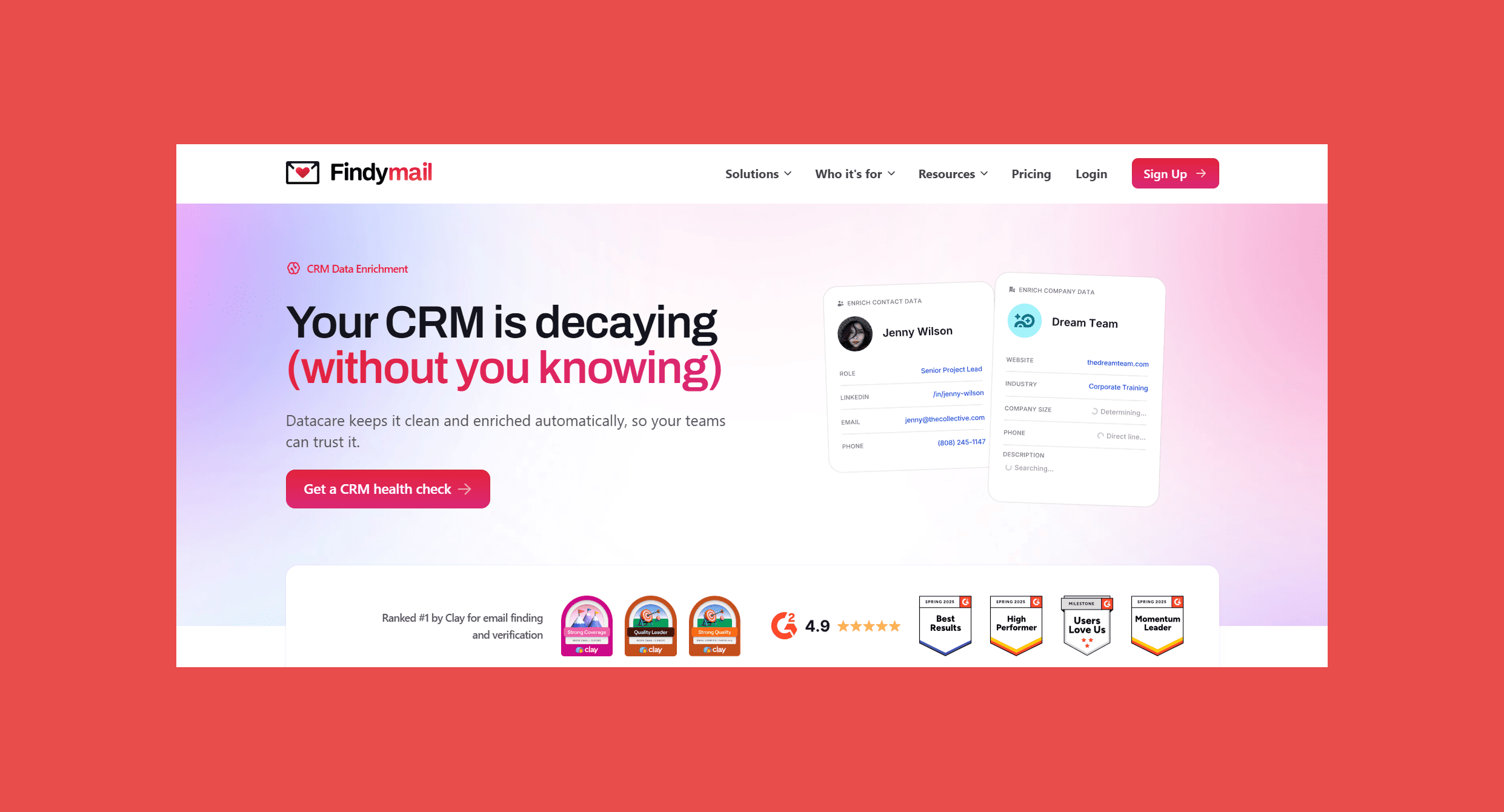
Most enrichment tools are built to answer: "What data can I add today?" You upload a list, they fill in the gaps, and for a week or two your CRM looks clean.
Datacare is built to answer a different question: "What changed in my CRM since yesterday?"
A champion switching companies on Tuesday doesn't care that you ran an enrichment project in March. A contact going stale in June doesn't wait for your next quarterly cleanup to become a liability. The risk isn't static, so a static fix can't touch it.
Datacare doesn't wait for a scheduled run to notice. It watches every record for the specific changes that create the four risks above:
- Fills in missing contact and company data as it finds gaps
- Keeps records fresh, removing invalid emails and refreshing outdated fields automatically
- Flags contacts the moment they switch jobs, so the record updates instead of going stale
- Catches duplicate contacts and companies before they pile up in your CRM
That's what turns the scorecard above from a spreadsheet you update once a quarter into a live number.
This is the actual gap between Datacare and a one-time enrichment tool. One gives you a clean database for a week. Datacare tells you the day a relationship starts to rot, not the quarter you happen to notice.
Datacare watches for the changes, not just the gaps: job moves, dead emails, accounts quietly going single-threaded, the moment they happen. That's the difference between cleaning your data once and keeping it honest all year.
Final Thoughts
Every revenue team measures pipeline, ARR, forecast accuracy, win rate. Almost none measure the reliability of the data those numbers are built on.
If your CRM can't tell you who still works there, who owns the relationship, or which accounts just went single-threaded, your forecast is a well-formatted guess.
Revenue loss doesn't start at "Closed Lost." It starts in the small gaps nobody measured. The teams that consistently outperform aren't better forecasters. They're better at catching risk while it's still just risk.
By now the real question isn't whether your CRM has hidden revenue risk. It's how much, and that's not something you can answer by reading an article. It's something a health check can actually show you.
A free Datacare CRM health check surfaces the champions who've gone quiet, the contacts rotting in the background, and the accounts one resignation away from going dark, before any of it shows up in a lost deal.

James Carter
James is a senior SaaS commercial leader specialising in enterprise sales, GTM strategy and revenue growth, with deep CRM platform expertise. He writes on CRM strategy to help revenue teams scale.


![A Field Guide to Finding the Right B2B CRM [2026 Comparison]](/blog/content/images/size/w300/2024/02/jukebox-print-FUohNQatzVs-unsplash.jpg)