AI Lead Finder
 Email Finder
 Email Verifier
 Phone Finder
 Intent Signals
 CRM Enrichment/Cleaning
 API
API

Everyone in B2B sales, marketing, and beyond knows Bombora. It's the name that comes up first in any conversation about intent data, the one other platforms license instead of trying to out-build. Premier tool, premier reputation.
Premier also means premium, and if you're reading this, you already know the deal: the pricing, the contract length, the account-level view that doesn't quite get you all the way to a person you can email.
This guide covers what Bombora actually does well, where that premium approach leaves gaps, and seven alternatives that fill them differently, including where Findymail fits in.
Findymail Signals tracks job changes, new hires, and topic engagement as they happen, then hands you the enriched contact instead of a delayed account score.
What This Guide Covers: How Bombora's intent data works, where teams tend to outgrow it, and seven alternatives that take different approaches to buying signals — from enterprise ABM to signal-driven prospecting.
The 7 Alternatives:
1. Findymail Signals – Real-time intent signals paired with lead enrichment
2. 6sense – Predictive intelligence for enterprise ABM
3. Demandbase – Account-based GTM platform with bundled intent
4. G2 Buyer Intent – Software research signals from G2's own traffic
5. TechTarget Priority Engine – Technology purchase intent from TechTarget's media network
6. Common Room – Digital and community signal aggregation
7. Leadfeeder – Website visitor and company-level signals
What Is Bombora?
What does Bombora do?
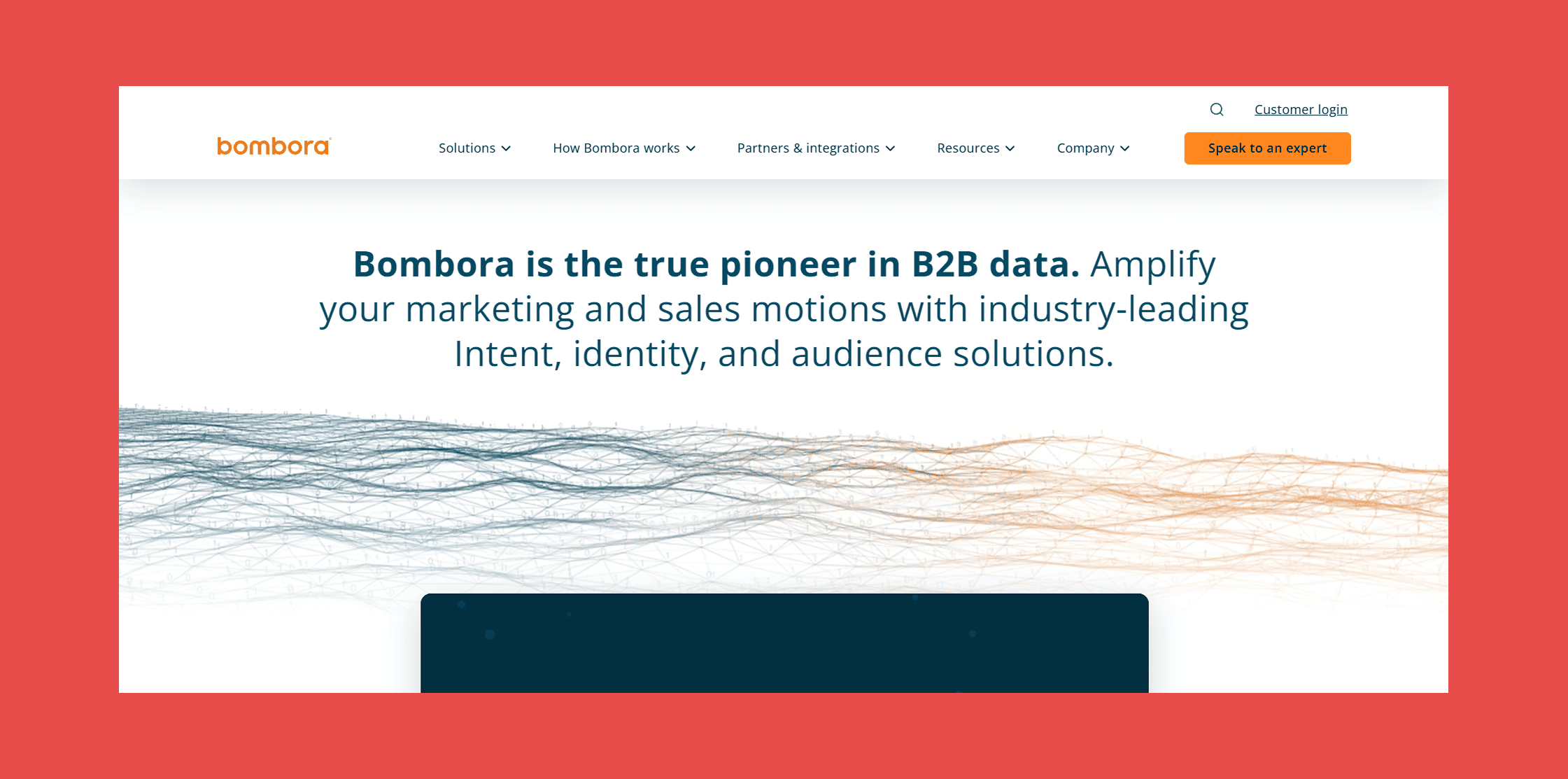
Bombora is the name most people reach for first when they say "B2B intent data." It doesn't sell contacts or a CRM. It sells account-level intelligence: which companies are actively researching topics that map to what you sell.
The flagship product, Company Surge, scores companies on a 0–100 scale based on how far their current research on a topic sits above their own historical baseline. A high score means an account is "surging," which sales, marketing, and ABM teams treat as a proxy for active buying interest and use to prioritize accounts or time outreach around research spikes. Even 6sense and Demandbase license Bombora's data as an input into their own scoring, which says something about how entrenched it is.
How does Bombora work?
The workflow runs roughly like this:
A publisher in Bombora's co-op, over 5,500 B2B media sites, records that someone from a company's IP is consuming content. Bombora maps that activity to one of its 20,000+ taxonomy topics and compares the volume against that account's own historical baseline. If the spike clears a threshold, it surfaces as a Company Surge signal, and teams plug it into their CRM or ABM platform to decide who gets outreach.
How much does Bombora cost?
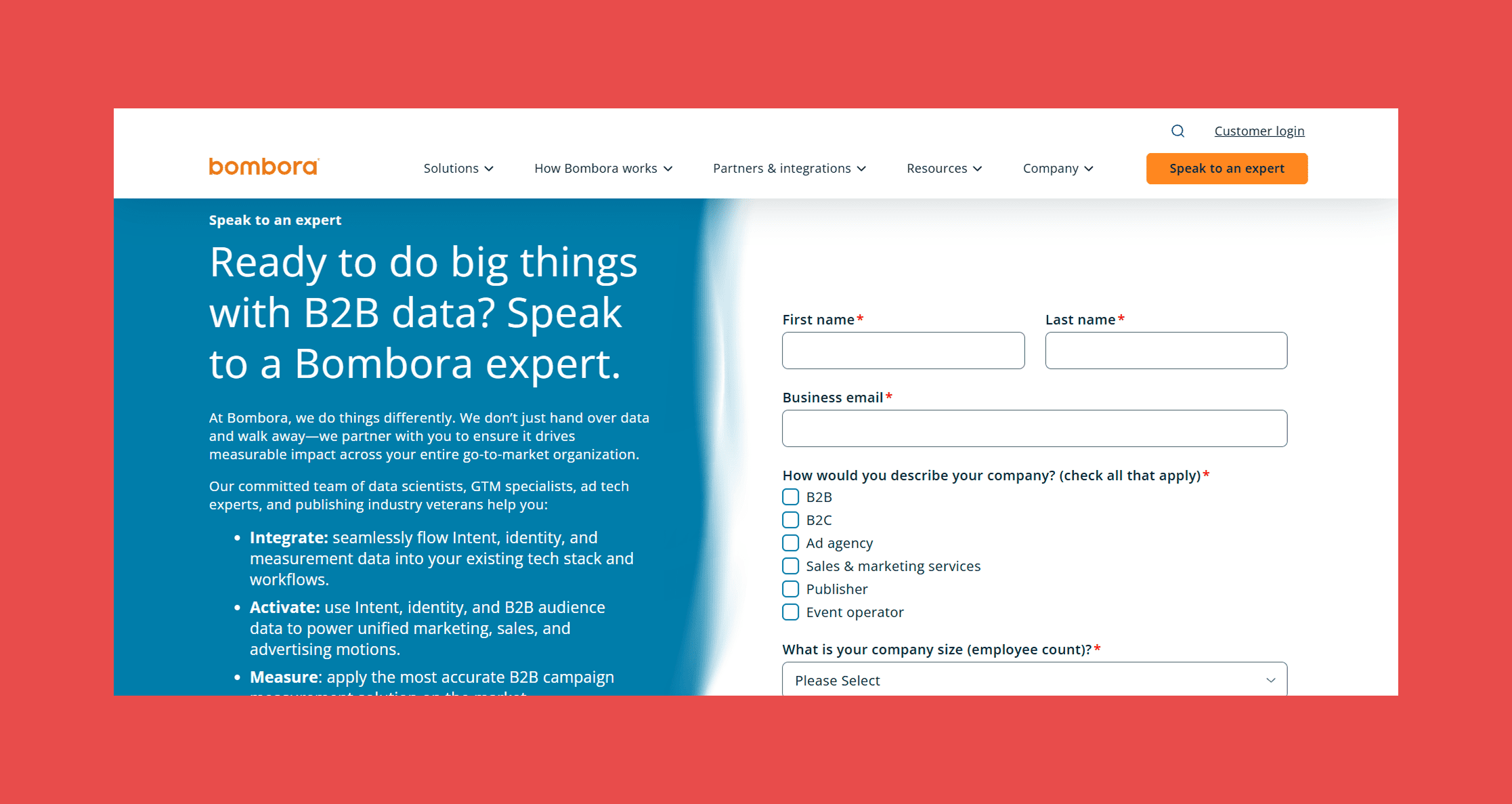
Bombora doesn't publish pricing anywhere on its site. Every deal runs through a sales conversation, and cost depends on how many topics you monitor, how many accounts you track, and which integrations you need.
- Entry-level contracts reportedly start around $25,000–$45,000/year for limited topic coverage
- Broader topic access or Audience Solutions (advertising) can push contracts past $100,000/year
- Enterprise deployments with custom intent tracking and global coverage have been reported north of $250,000/year
Bombora Review: Features, Strengths & Limitations
What Bombora does well
- Account-level B2B intent data built on a large, consent-based publisher co-op
- Topic-based intent signals across more than 20,000 taxonomy categories
- Company Surge scoring that compares current activity against an account's own baseline
- Widely used as a data layer inside 6sense, Demandbase, and other ABM platforms
- Strong fit for enterprise ABM and revenue-orchestration programs already built around it
- Native integrations with Salesforce, HubSpot, and Marketo
Where Bombora may fall short
These aren't universal weaknesses. They're situations where a different approach fits better.
- Account-level intent doesn't tell you who at the account to contact
- Teams still need a separate enrichment step to turn a "surging" company into a reachable person
- Weekly refresh (the default cadence) can miss faster-moving signals like a job change or a new hire
- The topic-and-content-consumption model doesn't capture signals like hiring or role changes
- Enterprise-oriented pricing and contract length may be more infrastructure than a smaller outbound team needs
- Teams focused on direct prospecting may want signals that connect straight to an enriched, contactable lead
Key takeaway
Bombora is built around account-level intent intelligence, and it's genuinely strong at that specific job: telling you which companies are researching topics relevant to your business. Teams that need fresher signal types, person-level detail, or contacts they can act on immediately are the ones most likely to go looking for something else.
Why Look for a Bombora Alternative?
Nobody's saying Bombora is bad at what it does. Teams evaluate alternatives for a handful of practical reasons:
- Need signals that translate directly into action, not just an account score
- Need person-level identification, not just a company name
- Want intent paired with contact enrichment in the same workflow
- Want signal types beyond topic research: job changes, new hires, keyword mentions
- Already run an outbound stack and need something that slots in without months of implementation
- Have a smaller budget that doesn't clear Bombora's typical contract size
- Prefer month-to-month or credit-based pricing over an annual commitment
Use these criteria as you work through the table and profiles below:
| Criterion | What to ask |
|---|---|
| Data and signal source | Where does the intent or signal data actually come from? |
| Signal freshness | How quickly does a signal reach you after it happens? |
| Coverage | What industries, company sizes, and geographies does the tool cover well? |
| Account vs. person-level identification | Does it name a company, a person, or both? |
| ICP filtering | Can you narrow signals to your actual target customer profile? |
| Lead enrichment | Does intent come paired with usable prospect information? |
| Contact information | Does the platform hand you an email, a phone number, or neither? |
| Integrations | How well does it connect to the CRM and sequencer you already use? |
| Automation | Can signals and leads reach your team without manual pulls? |
| Workflow flexibility | Can you adapt it to more than one type of prospecting motion? |
| Outbound capabilities | Does it support direct sales prospecting, or just marketing activation? |
| Pricing | Is the pricing model built for your team's size, or the enterprise's? |
| Ease of implementation | How long before the data is actually usable? |
7 Best Bombora Alternatives
Bombora's alternatives split into a few camps. Some, like 6sense and Demandbase, wrap intent inside a much larger enterprise ABM platform. Others specialize in a single signal channel: G2 tracks software research, TechTarget tracks technology media consumption, Common Room tracks community and digital activity, Leadfeeder tracks website visitors. Findymail Signals takes a different angle again, treating the signal as step one of a prospecting workflow rather than the whole product.
The right pick depends less on which tool has the most signal types and more on what your team actually does once a signal fires.
Comparison Table
| Tool | Best for | Core capability | Key feature |
|---|---|---|---|
| Findymail | Actionable intent for outbound | Real-time intent signals + lead enrichment | Signal → prospect → outreach |
| 6sense | Enterprise ABM | Predictive intelligence + intent | Revenue intelligence |
| Demandbase | Account-based GTM | ABM + intent | Account intelligence |
| G2 Buyer Intent | Software research intent | Buyer research signals | G2 category activity |
| Informa TechTarget | Technology research intent | Purchase intent from owned media | Named buyer access |
| Common Room | Digital and community signals | Community + product signal intelligence | Unified signal view |
| Leadfeeder | Website and company signals | Visitor identification | GDPR-native EU data |
1. Findymail — Best for Actionable Intent Signals
Findymail started as a straightforward alternative to prospecting tools that hand you an email address and leave the deliverability risk on you, and now covers an Email Finder, Phone Finder, Email Verifier, and Intellimatch (AI lead finder), all built around real-time verification.
Signals applies that same logic to timing: it's built around the idea that a signal is only worth as much as how fast you can act on it, so instead of stopping at "Company X is interested," it monitors the web for buying events (new hires, job changes, keyword mentions, topic engagement), filters them against your ICP, and enriches the result into an actual contactable person, complete with email and phone, pushed straight to your CRM or sequencer.
What it offers:
- 24/7 monitoring, not a weekly batch refresh
- Four signal types (New Hire, Job Title Change, Keyword Mention, Topic Engagement), each filterable by industry, company size, country, job title keywords, and seniority
- Custom monitors built around your ICP, so you're only tracking what matters
- Lead enrichment bundled into the same workflow, with verified email and phone
- Automated delivery to your CRM or sequencer, with native connections to HubSpot, Salesforce, Pipedrive, and more
How it works:
- Set up monitors around the signal types that matter to your pipeline.
- Filter those signals down to your ICP so you're not drowning in noise.
- Receive enriched leads that include the person, their contact details (optional), company data, job title, social URLs, and the signal context that triggered them.
- Take action directly from your existing prospecting workflow.
Ratings:
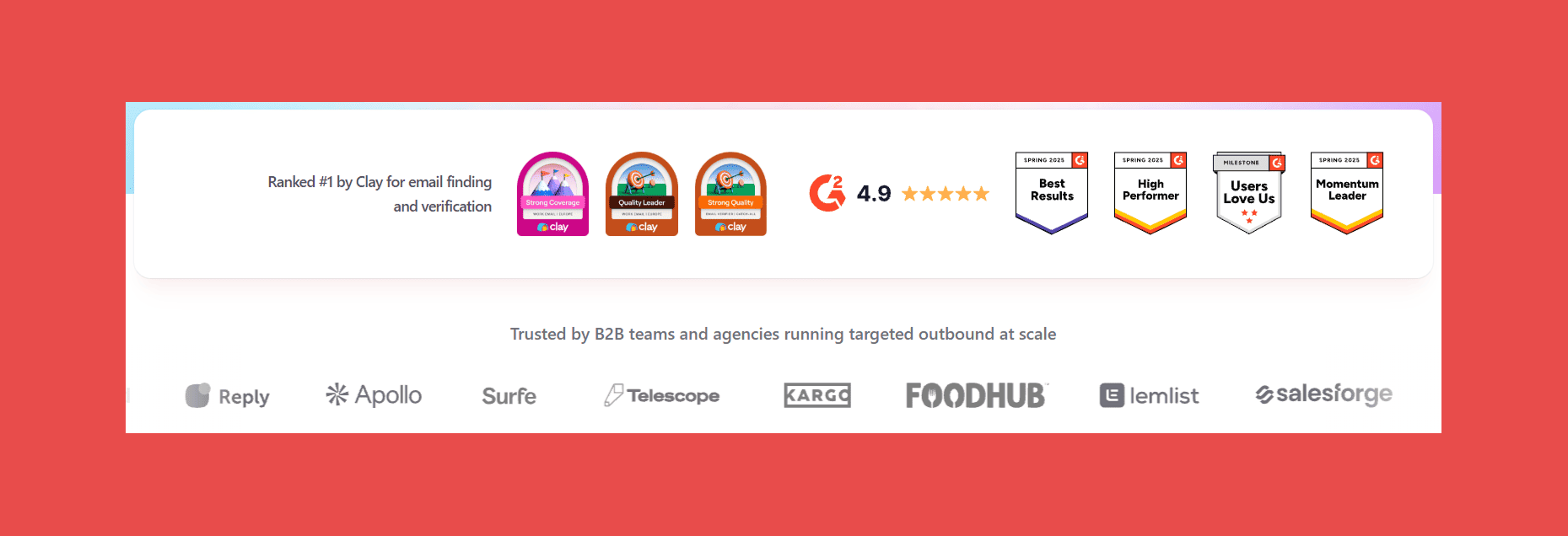
- G2: 4.9/5 (57)
- Capterra: 4.9/5 (7)
Pros:
- ICP-focused filtering means you're not sifting through every job change in the country
- Contact information ships with the signal, not as a separate step
- Built specifically around outbound prospecting, so the workflow ends at "ready to send," not "ready to research further"
Cons:
- No advertising activation or account-orchestration layer, so it won't replace a full enterprise ABM platform outright
- Signal types lean outbound-specific rather than the broad third-party topic taxonomy a co-op like Bombora offers
Pricing:
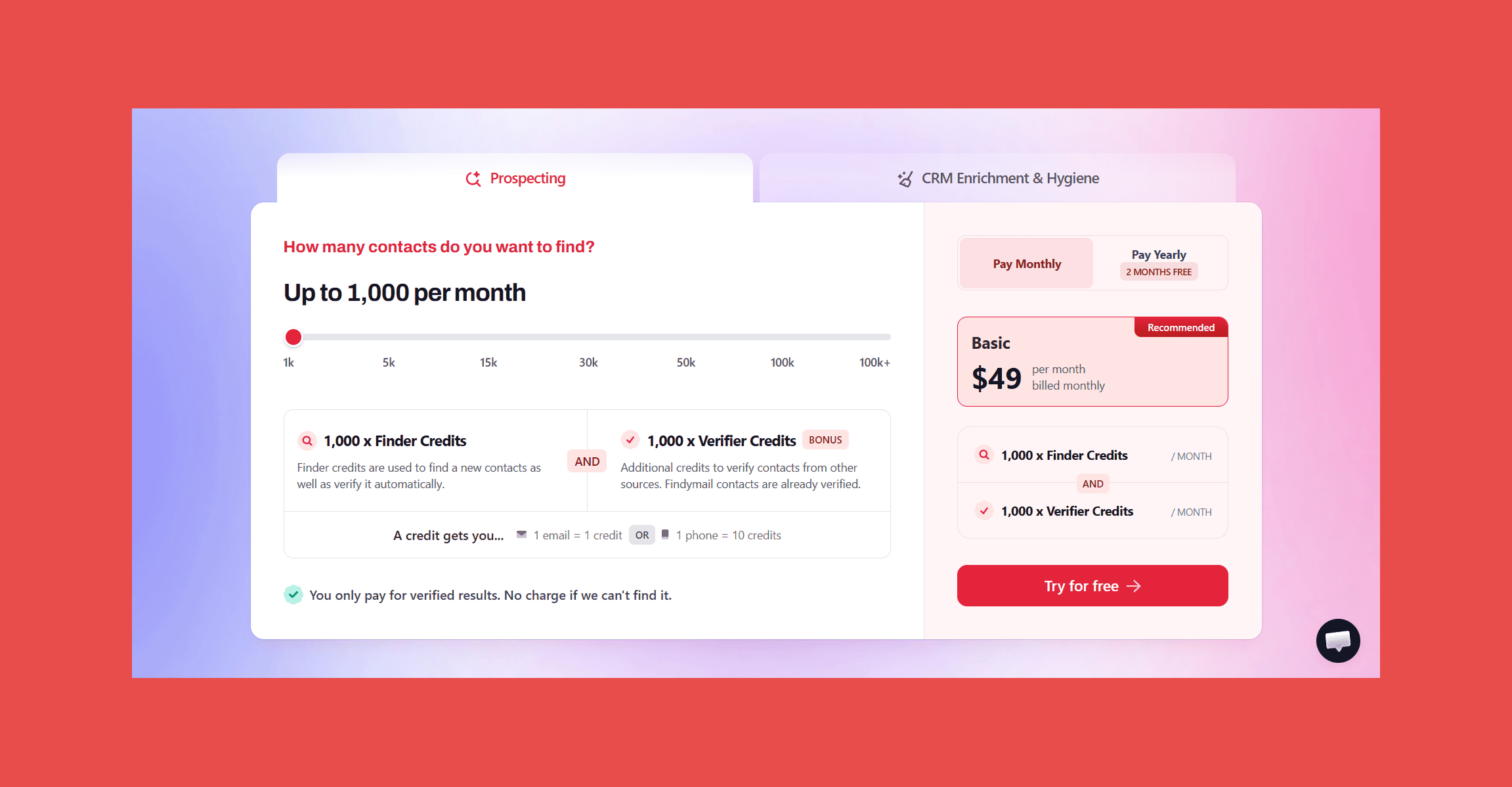
Findymail runs on a credit-based model. Every plan includes the full platform, higher tiers just mean more credits, nothing sits behind a paywall.
- Basic: $49/month, 1,000 Finder Credits and 1,000 Verifier Credits
- Starter: $99/month, 5,000 Finder Credits and 5,000 Verifier Credits
- Business: $249/month, 15,000 Finder Credits and 15,000 Verifier Credits
- Business Plus: $399/month, 30,000 Finder Credits and 30,000 Verifier Credits
- Scale 50K: $549/month, 50,000 Finder Credits and 50,000 Verifier Credits
- Scale 100K: $849/month, 100,000 Finder Credits and 100,000 Verifier Credits
- Enterprise: custom volume pricing with a dedicated account manager
Findymail Signals delivers the enriched contact alongside the signal itself, so there's no separate lookup step between noticing the trigger and sending the email.
2. 6sense — Best for Enterprise Predictive Intelligence
6sense falls into a similar category as Bombora: both are built around third-party intent data used to prioritize accounts. Where it differs is scope. 6sense doesn't just flag research activity, it layers predictive buying-stage modeling on top, using AI trained on both first- and third-party signals (including licensed Bombora data) to estimate where an account sits in its buying journey.
What it offers:
- Predictive intelligence and buying-stage scoring
- Intent data layered across first- and third-party sources
- Account identification, including "dark funnel" activity
- Advertising and orchestration modules for full-funnel activation
- Intent signals refresh daily, though full account scoring runs on a slower monthly cycle
- Native integrations across major CRMs, marketing automation, and sales engagement tools, with API access for custom setups
- Intelligent Workflows that can trigger a sales alert, a sequence enrollment, or an ad launch automatically once an account changes stage
How it works:
Ratings:
- G2: 4.5/5 (2,546)
- Capterra: 4.6/5 (30)
Pros:
- Predictive scoring backed by real analyst recognition, not just a raw intent feed
- Aggregates intent across many sources instead of relying on one channel
- Native advertising orchestration cuts down on needing a separate DSP
Cons:
- Requires dedicated RevOps resourcing to configure and maintain
- Implementation and onboarding commonly take several months, so you're financially committed before you know if it's working
- Person-level contact data is a weaker point than its account-level intelligence
- A steep cost and complexity floor for smaller teams
Pricing:
- Not published. Reports suggest plans run into the tens of thousands of dollars annually and scale up sharply for full enterprise access, though a free Sales Intelligence tier is also available.
3. Demandbase — Best for Account-Based GTM
Demandbase bundles account intelligence, intent data (including licensed Bombora signals), advertising, and sales activation into a single account-based GTM platform, marketed as "Demandbase One."
What it offers:
- Unified account intelligence combining firmographic, technographic, and engagement data
- Third-party intent data as one module among several
- ABM advertising and personalization
- Account identification and prioritized targeting
- Intent captured directly through its own advertising bidstream, so signals reflect activity close to real time rather than a batched third-party feed
- Native integrations with major CRMs, marketing automation platforms, and ad networks, plus its own DSP and warehouse-native delivery
How it works:
Ratings:

- G2: 4.4/5 (1,987)
- Capterra: 4.3/5 (17)
Pros:
- Captures intent directly through its own bidstream and DSP, not just resold third-party data
- Person-Based Intent names the specific contact behind a signal, not just the account
- Buying-committee mapping goes beyond single-contact intent
Cons:
- Full platform pricing bundles sales and marketing together rather than offering cheaper standalone options
- Considerable setup complexity for smaller marketing teams
Pricing:
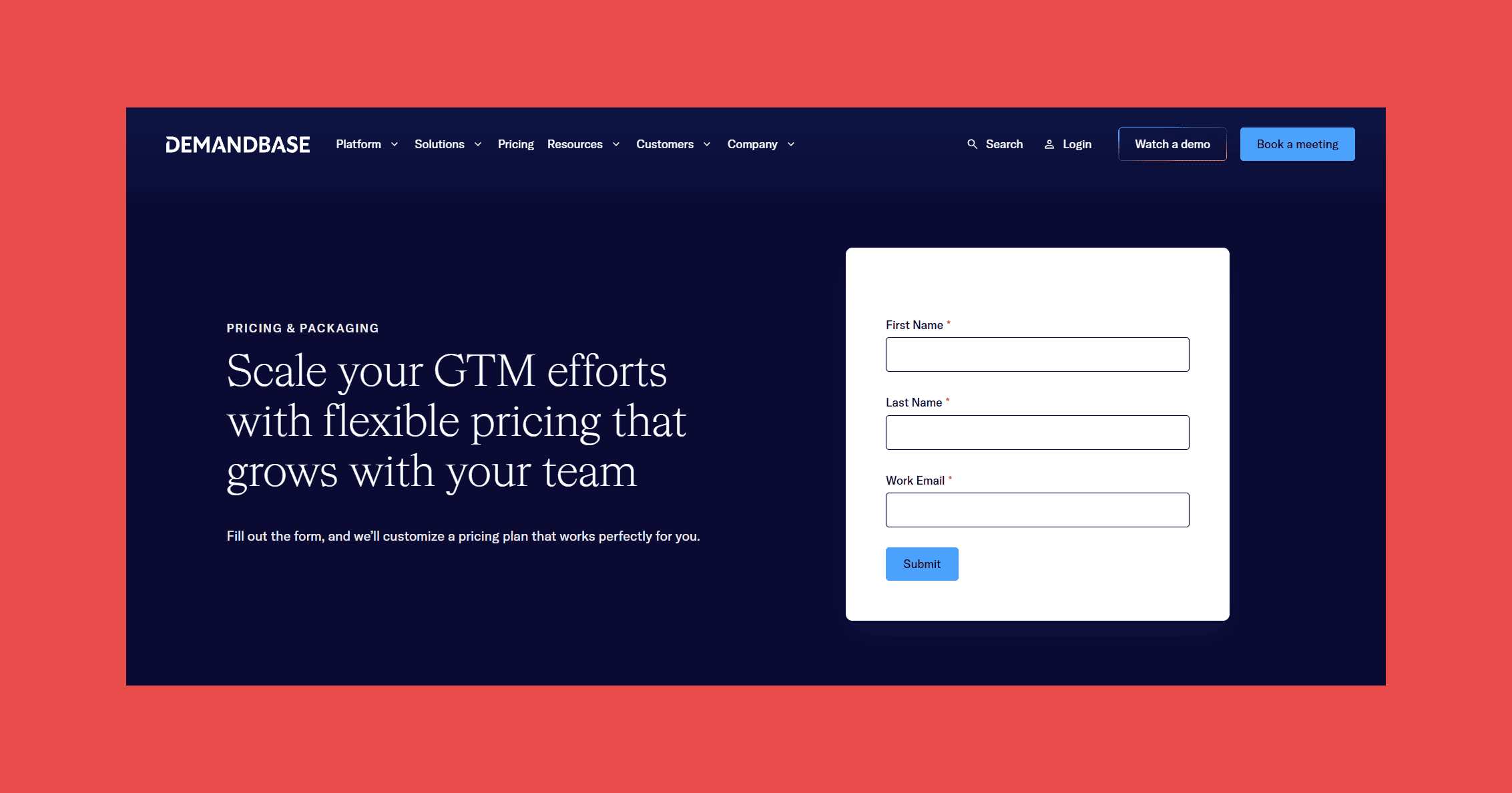
- Not published. Reported annual contracts commonly range from roughly $25,000 for smaller packages to well over $100,000 for full enterprise deployments.
4. G2 Buyer Intent — Best for Software Buyer Research Intent
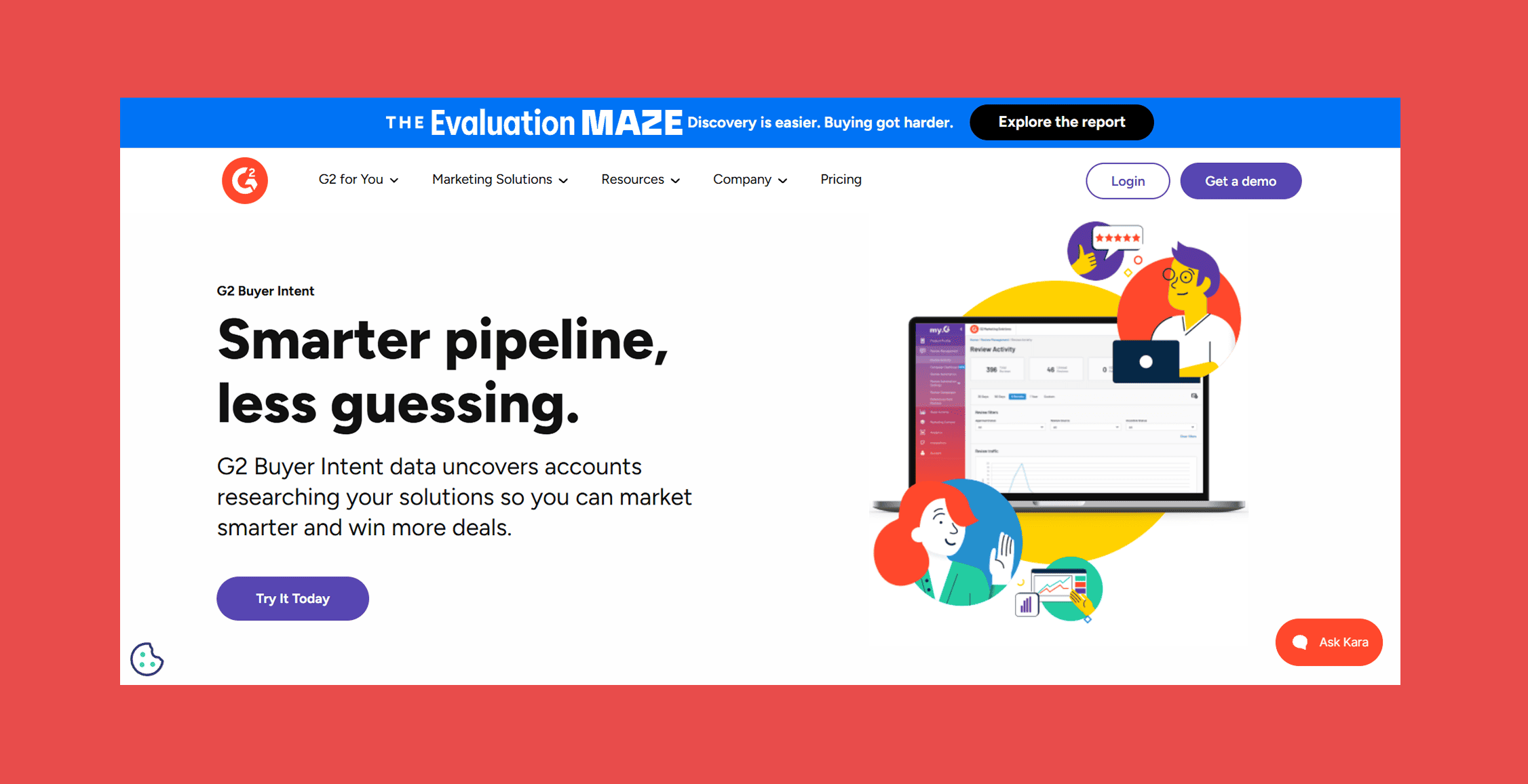
G2 Buyer Intent captures a specific, high-value slice of research behavior: companies actively viewing your G2 profile, comparing you to named competitors, or browsing your software category.
What it offers:
- Profile-visit signals tied to a specific company
- Category-level research activity
- Competitor-comparison signals
- CRM integrations for Salesforce, HubSpot, and Marketo
How it works:
Ratings:
- G2: 4.6/5 (5,872)
- Capterra: 4/5 (9)
Pros:
- Signals reflect direct research actions like page views and comparisons, not an inferred pattern
- Includes competitor-comparison page data that most other providers on this list don't track
Cons:
- Limited to G2 platform activity only, no visibility into research happening elsewhere
- Account-level, not person-level
- Requires an existing paid G2 Marketing Solutions package before you can even add it on
- No published pricing and no self-serve trial for the add-on itself
Pricing:
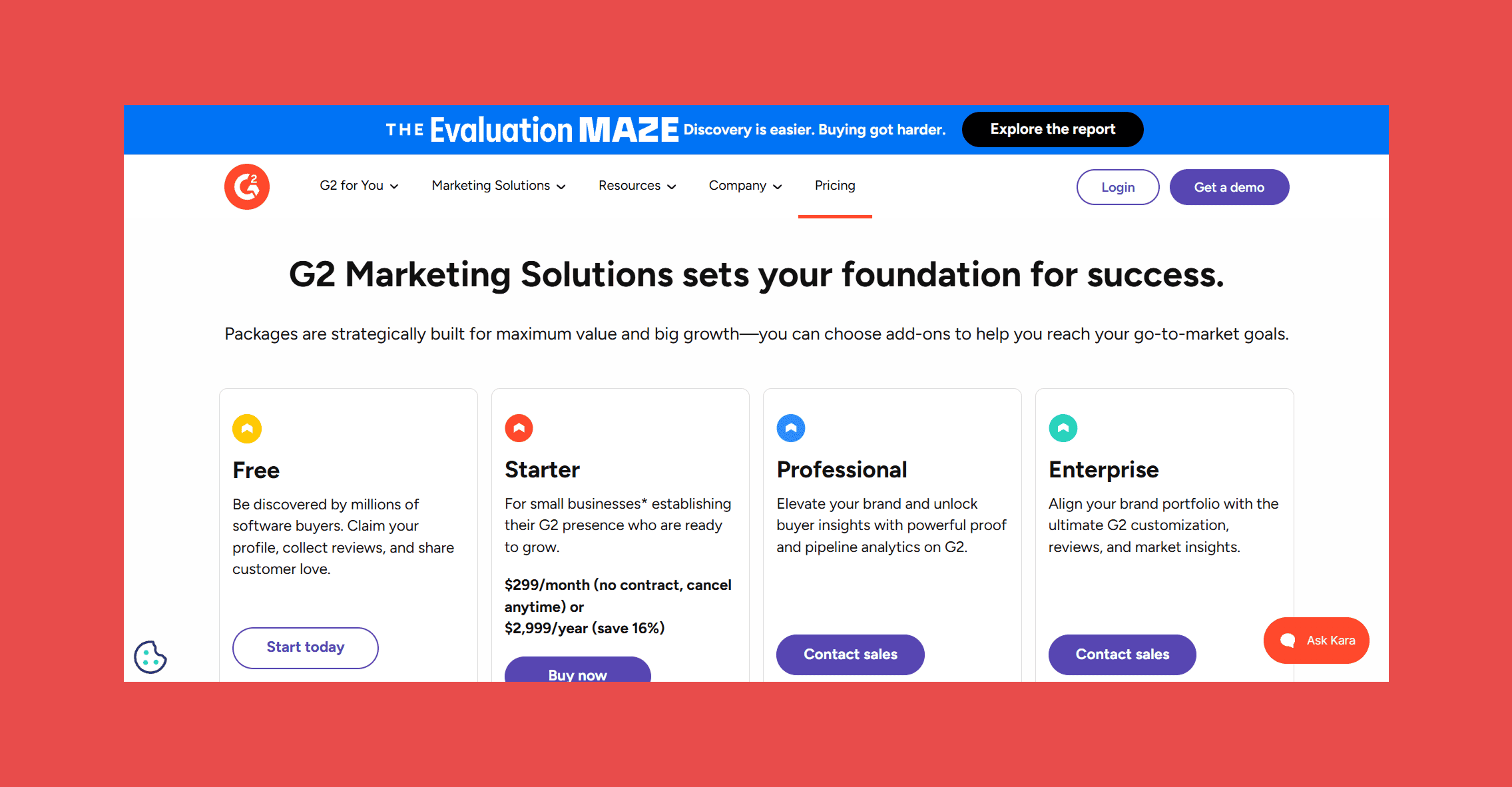
- G2 Marketing Solutions itself is published: Free, Starter at $299/month or $2,999/year (self-serve), and Professional or Enterprise on request.
- Buyer Intent is an add-on available only on the Professional and Enterprise tiers, and its own price isn't published, you'll need to talk to sales even after you're already a paying G2 customer.
5. Informa TechTarget — Best for Technology Research Intent
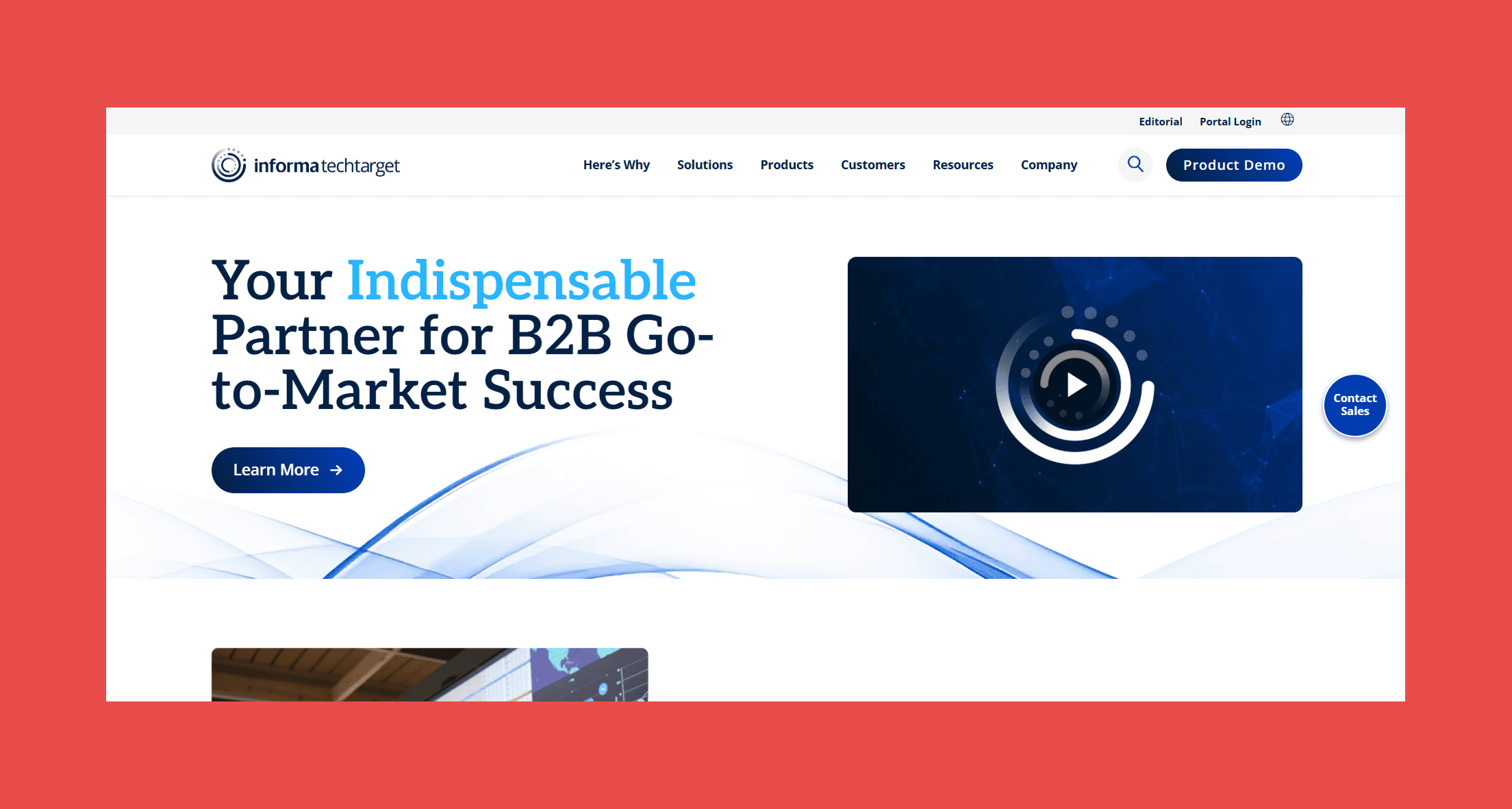
Informa TechTarget runs one of the largest networks of B2B technology media properties, and Priority Engine turns reader behavior on that network into named-account (and in some tiers, named-buyer) purchase intent.
What it offers:
- Purchase intent sourced from Informa TechTarget's own technology media sites
- Weekly refresh with newly validated in-market accounts
- Named buyer access in addition to account-level scoring
- Delivered via portal, CRM integration (Salesforce and other major CRMs), or data export, with ROI dashboards built in
How it works:
Ratings:
- G2: 4.3/5 (453)
- Capterra: N/A
Pros:
- One of the few providers on this list offering contact-level rather than account-level intent
- Signals come from an opted-in audience, not anonymous web tracking
Cons:
- Coverage skews heavily toward technology buyers, and depth varies by topic, geography, and role even within tech
- User feedback on contact accuracy is mixed, worth testing against your own target accounts first
- No workflow automation or outbound execution built in, CRM enrichment is a basic data push
Pricing:
- Not published. Reports commonly put entry-level packages around $30,000/year, climbing well past $100,000 for enterprise access.
6. Common Room — Best for Digital and Community Signals
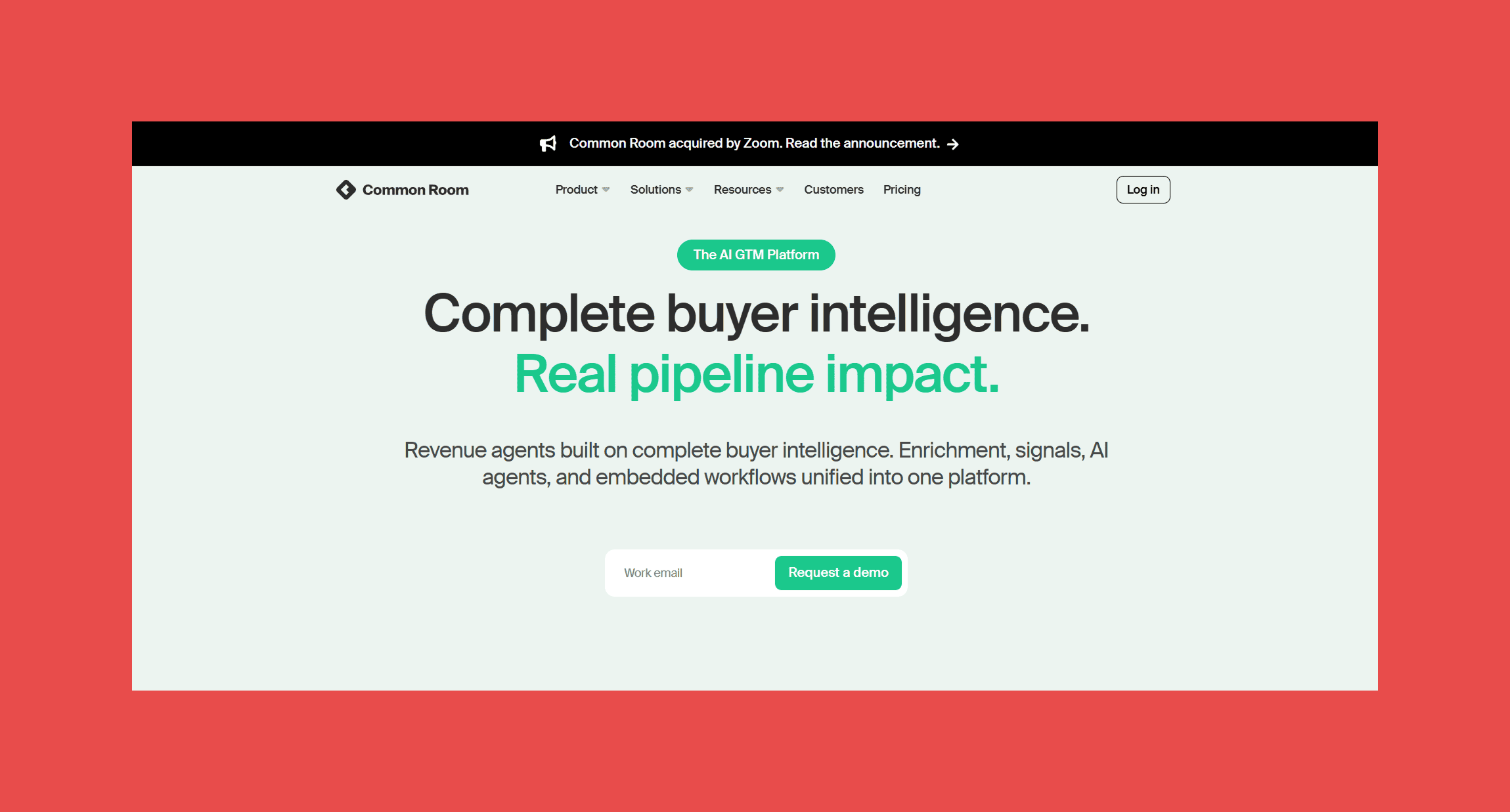
Common Room aggregates signals across community platforms (Slack, Discord, GitHub), website activity, product usage, and licensed third-party intent (including a limited allotment of Bombora topics) into one unified view.
What it offers:
- Community engagement signals across connected platforms
- Website and product usage tracking
- Person-and-account identification
- Automated workflows and AI-assisted research credits
- CRM sync, Slack and email alerting, and data warehouse integrations, plus connections to community platforms like Discord and Reddit (some gated to higher tiers)
- RoomieAI Spark turns a unified signal into a real-time Slack or email alert telling a rep who to engage and why
How it works:
Ratings:
- G2: 4.5/5 (114)
- Capterra: N/A
Pros:
- Captures a signal type Bombora doesn't touch at all: public community activity before anyone talks to sales
- Strong fit for teams with an active developer community or PLG motion
Cons:
- Less valuable without several existing data sources worth consolidating, the core pitch is unification
- Pricing scales quickly with contact volume and added signal sources
- Less useful for traditional outbound teams without a community or PLG motion
- Most of the work still happens in its own dashboard, even with CRM sync available
Pricing:
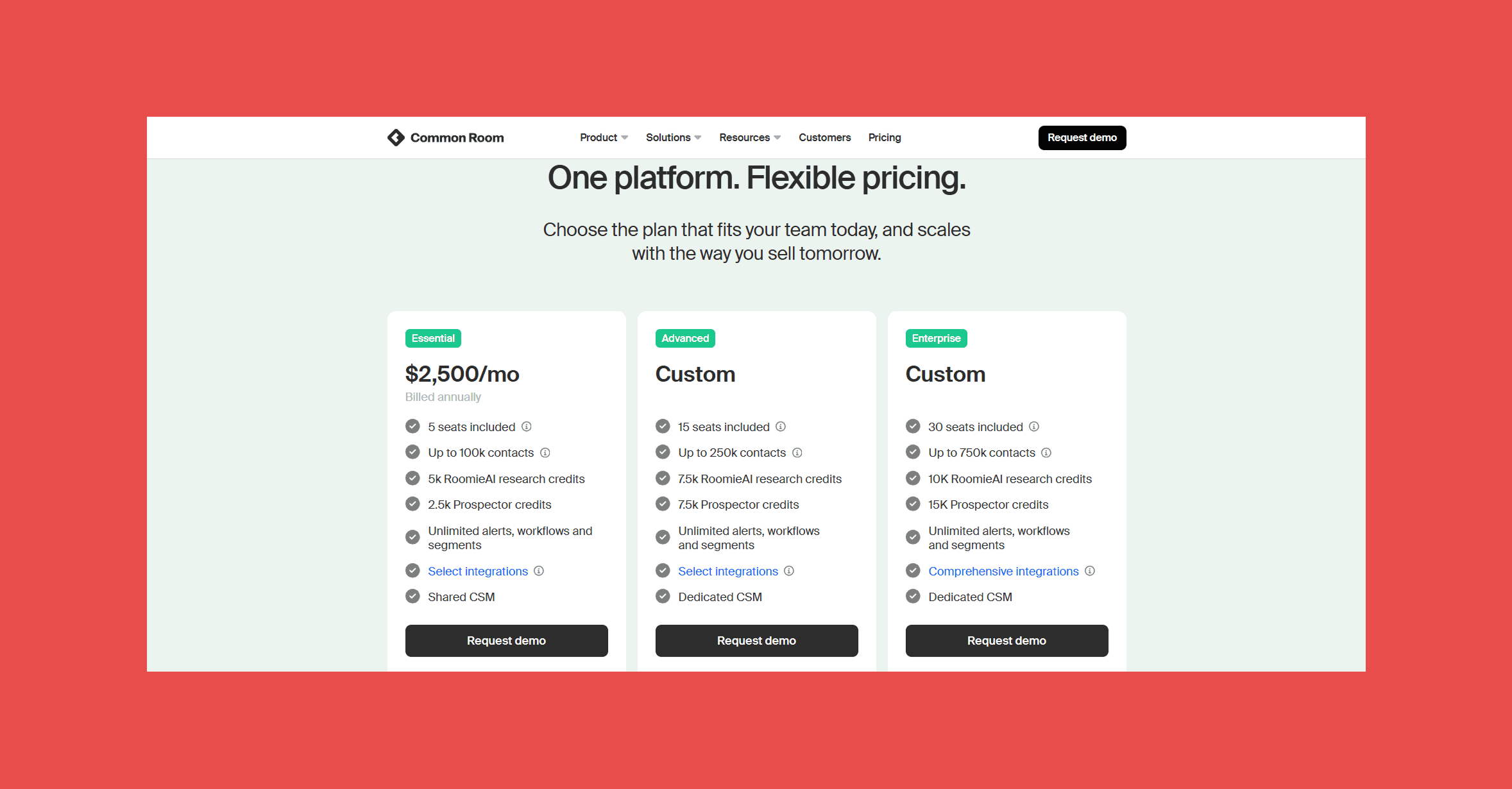
- Essential plan published at $2,500/month billed annually for 5 seats, up to 100,000 contacts, 5,000 RoomieAI research credits, and 2,500 Prospector credits.
- Advanced and Enterprise tiers scale up seats, contacts, and credits, and are custom quoted.
7. Leadfeeder — Best for Website and Company Signals
Leadfeeder was Dealfront until its 2025 rebrand folded the Dealfront and Echobot products back under the Leadfeeder name. Same platform, same team, new name. It identifies which companies visit your website and are actively in-market, then helps you turn that traffic into a prioritized list of accounts and decision-makers worth reaching out to.
What it offers:
- Web Visitors: identifies companies visiting your site, even anonymous traffic that never fills out a form, with real-time alerts
- Target: an ICP-based prospecting tool with 100+ filters to find companies and decision-makers that match a saved list
- Trade-register-sourced European company data
- Personalized outreach built from actual website visits and firmographic profiles
- Upsell and cross-sell signals from existing customers' real-time site activity
- GDPR-native data hosting and per-record source traceability
How it works:
- Set up a Custom Feed in Web Visitors, filtering by signals like company country, industry, or employee count.
- Save the matching companies to a List.
- Move to Target and search filtered by that List.
- Layer on more of Target's 100+ filters to narrow down to the right decision-makers at each company.
Ratings:
- G2: 4.3/5 (865)
- Capterra: 4.2/5 (135)
Pros:
- GDPR-native compliance and trade-register accuracy matter as much as the signal itself for European-focused teams
- A lower-friction entry point than most intent tools on this list
- Free Lite plan runs forever, not just a trial, a real way to test company identification before paying
Cons:
- Verified contact details, intent-signal filtering, and CRM automation are gated behind the pricier Activate and Scale tiers, not available on the entry-level plans
- Value depends on having meaningful website traffic to identify in the first place; low-traffic sites get a lot less out of it
- Coverage thins out noticeably outside DACH and the Nordics
Pricing:
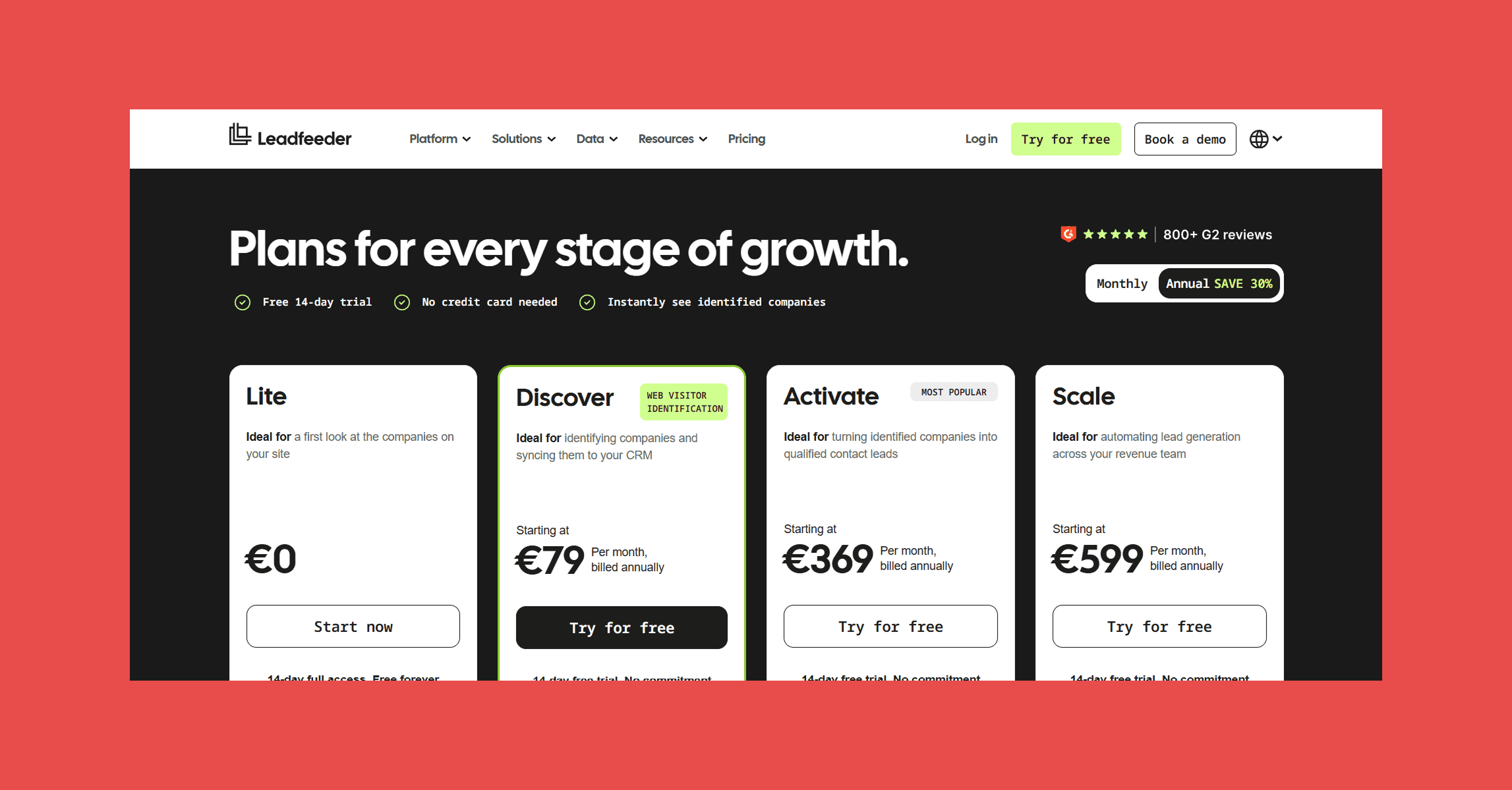
Runs on a credit-based system across five tiers.
- Lite: Free forever, unlimited users, 7-day visitor history, last 100 companies/month
- Discover: From €113/month billed monthly, adds real-time alerts, CRM push, and outreach automation
- Activate: From €527/month billed monthly, adds verified emails and phones, intent-signal filtering, campaigns, and CRM automations
- Scale: From €599/month billed annually, adds free company-data export, automatic CRM updates, and a dedicated CSM
- Enterprise: Custom identification and credit volume, with a dedicated team
Final Thoughts
Bombora earned its reputation honestly: a huge publisher co-op, a real scoring methodology, and enough exclusive data that competitors license it instead of competing. If you run account-level ABM already, it's still a fine default.
But alternative doesn't mean worse, it means different tradeoffs.
- 6sense and Demandbase go bigger with predictive modeling
- G2 and Informa TechTarget go narrower, one channel each
- Common Room catches community activity Bombora can't see
- Leadfeeder trades breadth for EU compliance
Findymail's Signals feature takes the outbound route instead: a filtered signal paired with an enriched contact, ready to act on the same day. It's not an enterprise ABM suite, and it isn't trying to be.
There's no universal winner. Just the right fit for what you actually do once a signal fires.
Findymail Signals hands you both in the same step, ready to act on the same day, no enterprise ABM suite required.
Frequently Asked Questions About Bombora Alternatives
What are the best Bombora alternatives?
6sense and Demandbase for enterprise ABM, G2 Buyer Intent and Informa TechTarget for channel-specific research signals, Common Room for community and product-usage signals, Leadfeeder for European website visitor ID, and Findymail for turning a signal into an enriched, contactable prospect.
Who are Bombora's main competitors?
6sense and Demandbase compete most directly, and both actually license Bombora's data rather than replacing it. G2, TechTarget, and Common Room compete on distinct signal sources. Findymail competes on turning a signal into action, not data breadth.
What is the best Bombora alternative for B2B intent data?
6sense and Demandbase are closest to Bombora's account-level model. G2 and TechTarget offer narrower, higher-confidence signals from one channel. Findymail adds signal types, like new hires and job changes, that none of the others treat as core.
What is the best Bombora alternative for outbound sales?
Findymail: signals filtered to ICP, delivered with contact info attached, built for a prospecting workflow rather than a marketing dashboard.
Is there a Bombora alternative with real-time intent signals?
Bombora refreshes Company Surge weekly by default. Findymail monitors continuously, which matters most for fast-moving triggers like a job change, where a week's delay can already be too late.
Is there a Bombora alternative with lead enrichment?
Findymail bundles enrichment into the same workflow as the signal. Most others here, Bombora included, treat it as a separate step.
How does Findymail compare with Bombora?
Bombora tells you a company's research is spiking. Findymail tells you the specific person behind it, a job change, a promotion, a topic engagement, and hands you their verified contact in the same step. One's account-level intelligence; the other's a signal-to-contact workflow.
How much does Bombora cost compared with its alternatives?
Bombora, 6sense, Demandbase, and Informa TechTarget use custom, sales-led pricing; reported contracts run from the low tens of thousands into six figures. G2 Marketing Solutions is published (free to $299/month), though Buyer Intent itself isn't priced. Common Room starts at $2,500/month. Leadfeeder has a free tier and paid plans from ~$99/month. Findymail is included in every plan starting at $49/month.
What should you look for in a Bombora alternative?
Signal freshness, account vs. person-level identification, ICP filtering, whether enrichment ships with the signal, CRM integration depth, and whether the pricing model fits your team's size rather than an enterprise budget.

Valentin
Valentin Wallyn is the founder and CEO of Findymail, a SaaS platform he launched to help B2B teams discover accurate email and contact data and automate data enrichment at scale. With an IT background, Valentin combines a technical mindset with hands-on experience in outreach and growth. His work centers on improving data quality and prospecting efficiency, drawing on years of entrepreneurial experience and a deep understanding of what makes outreach campaigns succeed.