AI Lead Finder
 Email Finder
 Email Verifier
 Phone Finder
 Signals
 CRM Enrichment/Cleaning
 API
API

Your best prospects are researching solutions right now, comparing vendors in private Slack groups, asking peers for recommendations, and quietly building a shortlist before they reply to a single cold email. You'll never see any of it. This is the dark funnel, and it's where most of the B2B buying journey lives.
The fix isn't more outreach, it's better timing. The teams who spot them first are winning. This guide shows you how.
Findymail Signals monitors the web 24/7, filters leads by your ICP, and delivers enriched contacts ready to contact, without the enterprise price tag.
What Is Signal-Based Selling? Signal-based selling is a sales methodology where every rep action (from initial outreach to deal progression) is triggered by observable buying events at target accounts rather than arbitrary cadences or gut feeling. Instead of working a static list, reps focus on accounts showing real-time evidence of a buying window.
Why It Matters:
1. The Dark Funnel is Real: B2B buyers spend only 17% of their buying cycle talking to vendors. The rest happens out of sight, in peer communities, private Slack groups, and AI-assisted self-research.
2. Timing is Everything: Teams that act on intent signals within 24 hours see a 29% lift in opportunity creation compared to slower responders.
3. The Numbers Back It Up: Signal-personalized outreach achieves 15–25% reply rates vs. the 3–5% industry average for cold email (a 5x improvement).
4. Signals Have a Shelf Life: A funding round loses urgency after 48 hours. A new VP hire has a 30–90 day window. Act fast or lose the opportunity to a competitor.
The Top Signal-Based Selling Tools:
1. Findymail Signals — Signal monitoring + verified contact data in one workflow, starting at $49/mo
2. 6sense — Best for predictive AI scoring and full-funnel ABM execution
3. Bombora — Best for enterprise teams needing best-in-class third-party intent data
4. Clay — Best for RevOps teams that want fully custom signal workflows
5. Lead Onion — Best for all-in-one intent detection and outreach activation
6. Demandbase — Best for account-based marketing at enterprise scale
7. Apollo.io — Best affordable entry point for SMBs and early-stage teams
What Is Signal-Based Selling?
Signal-based selling is a sales method where every rep’s action, from initial outreach to deal progression, is triggered by an observable event (buying signals) at target accounts rather than following arbitrary cadences or gut feelings. Instead of working down a static list from top-to-bottom, reps focus on accounts showing real-time evidence of a buying window.
Think of it as the difference between knocking on random doors and knowing exactly which door is about to open.
Why Signal-Based Selling Matters?
The buying journey hasn't changed (Awareness → Consideration → Decision). But the buyer has. And that changes everything.
- Today's B2B buyer is self-sufficient, skeptical, and digitally native. 89% of B2B buyers now use generative AI for self-guided research before ever engaging a vendor.
- B2B buyers spend only 17% of their buying cycle actually talking to sales reps, with 67% actively preferring a rep-free experience altogether.
- And then there's the demographic shift that most sales teams are still sleeping on. Millennials and Gen Z now hold 64% of B2B buying roles, a generation that grew up ignoring ads, skipping cold calls, and doing their own research. They don't trust reps. They trust peers, communities, and content. Cold outreach isn't just ineffective with them, it's actively off-putting.
The takeaway? Your buyers are forming opinions, building shortlists, and making decisions long before they talk to you. If you're waiting for them to raise their hand, you've already lost.
How to Build Your Signal-Based Selling Playbook for 2026 and Beyond
Knowing that signals matter is one thing. Building a repeatable system around them is another. The teams seeing the best results aren't just reacting to signals as they come in, they've built a structured playbook that tells every rep exactly what to watch for, when to act, and what to say. Here's how to build yours.
Step 1: Map Your ICP
Before you track a single signal, know exactly who you're tracking it for. Not all buyers follow the same path, enterprise accounts have longer cycles and more stakeholders than SMB deals. Segment by company size, industry, seniority, and buying committee structure. The tighter your ICP, the more relevant your signals.
A few examples of what a well-defined ICP looks like in practice:
- SaaS tool for sales teams: B2B SaaS companies, 50–500 employees, VP of Sales or RevOps, Series A–C funded.
- Recruitment software: HR Directors or Talent Acquisition Managers at high-growth startups actively posting 10+ jobs per month.
- Finance automation platform: CFOs or Finance Managers at mid-market companies ($10M–$100M revenue) in manufacturing or logistics.
The point isn't to cast the widest net, it's to make sure every signal you catch is actually worth acting on.
Step 2: Identify Your Critical Touchpoints
Map every interaction that matters: website visits, content downloads, pricing page views, demo requests, and competitor comparisons. Pull from your CRM, analytics tools, and customer interviews to build a full picture of what a buying journey actually looks like for your product.
Start by asking: which touchpoints have historically preceded a closed deal? For most B2B teams, it looks something like this:
- Topic engagement → A prospect actively consuming content around a problem you solve, early-stage intent, perfect for getting in before the shortlist forms
- New hires → A company building out a team in your product's domain is investing in the problem you solve, reach out before they've committed to a solution
- Job changes → A new decision-maker in seat means fresh budget, fresh priorities, and no loyalty to the incumbent vendor
The goal isn't to track everything, it's to identify the 2–3 touchpoints that most reliably signal a buying window for your specific product, and build your plays around those first.
Step 3: Build a Play Around Each Signal
Every signal should trigger a specific, pre-built approach. No improvising.
Step 4: Act Fast
Signals have a shelf life. A job change is most actionable in the first 7–14 days. A pricing page visit needs a follow-up within hours, not days. Build response time targets into your playbook and treat them like SLAs — because your competitors are watching the same accounts.
The Types of Signals Worth Tracking
Not all signals are created equal. A single signal suggests interest. Stacked signals confirm a buying window, and the difference in reply rates is 5 to 10x. Here are the four core signal categories every B2B team should be monitoring:
1. Personnel Signals
These are your highest-converting signals. A new VP of Sales has a mandate to prove themselves. A recently promoted ops leader is evaluating tools. Someone who just joined a company in your ICP is starting fresh, and open to new vendors.
- New hires at target accounts.
- Job title changes and promotions.
- Key executive departures (the replacement is often re-evaluating the entire stack).
2. Intent & Topic Signals
Intent data reveals which accounts are researching your product category, even if they haven't visited your site yet. Review site activity shows active vendor evaluation and comparison shopping. These are early-stage signals, great for getting in before the shortlist solidifies.
3. Keyword & Social Mentions
When a prospect publicly posts about a problem you solve, that's an invitation. Monitor for:
- Prospects venting about a pain point your product addresses.
- Mentions of competitor products or switching intent.
- Industry keywords that signal active evaluation.
4. Company Event Signals
Recent funding is strongest 2–4 weeks post-announcement. A new VP hire opens a 30–90 day window. Pricing page visits decay within 5–10 days. Company events create urgency, but only if you act fast.
- Funding rounds (Series A, B, and beyond)
- Leadership changes
- Technology stack changes indicating budget shifts or vendor consolidation
The Top Signal-Based Selling Tools
Building a signal-based selling motion manually is possible, but it's slow, messy, and hard to scale. The fastest way to operationalize it is with the right tools. The best signal platforms do the heavy lifting for you: monitoring the web 24/7, filtering leads to your ICP, and delivering enriched contacts ready for outreach. Here are the best tools in the space right now.
1. Findymail Signals → Best for: Signal monitoring + verified contact data in one workflow
Overview:
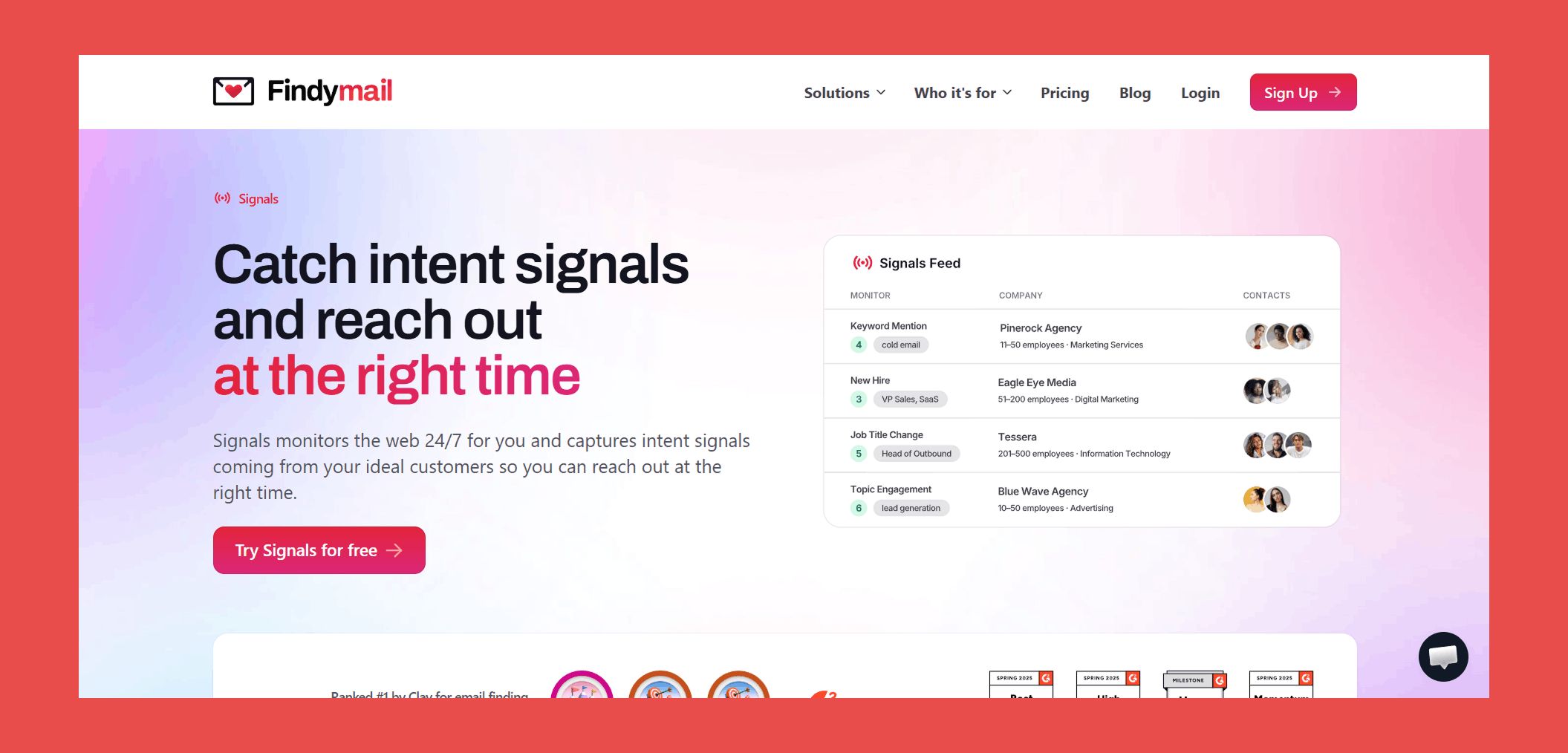
Most signal tools give you the trigger, then leave you to chase down the contact. Findymail Signals does both. Signals monitors the web around the clock for buying events, matches them to your ICP, and delivers leads that are already enriched with verified emails, phone numbers, and company data. The result is a faster path from signal to sent email, without the three-tool stack most teams are cobbling together.
Key Features:
- Signals: New Hire, Job Title Change, Keyword Mention, and Topic Engagement (all running continuously in the background, filterable by industry, company size, country, seniority, and job title).
- Auto-Enriched Leads: Every signal comes with the option of including company data, job title, and LinkedIn URL.
- Email/Phone Finder: Real-time verification at the moment of request
- Catch-All Email Verification: Syntax validation, DNS, SMTP, catch-all detection, and disposable email screening — returning a definitive deliverable verdict, not a "risky" catch-all.
- Intellimatch: Describe your ideal customer in plain English and get a verified, enriched lead list back in seconds.
- Security: SOC 2 and GDPR compliant.
Ratings:
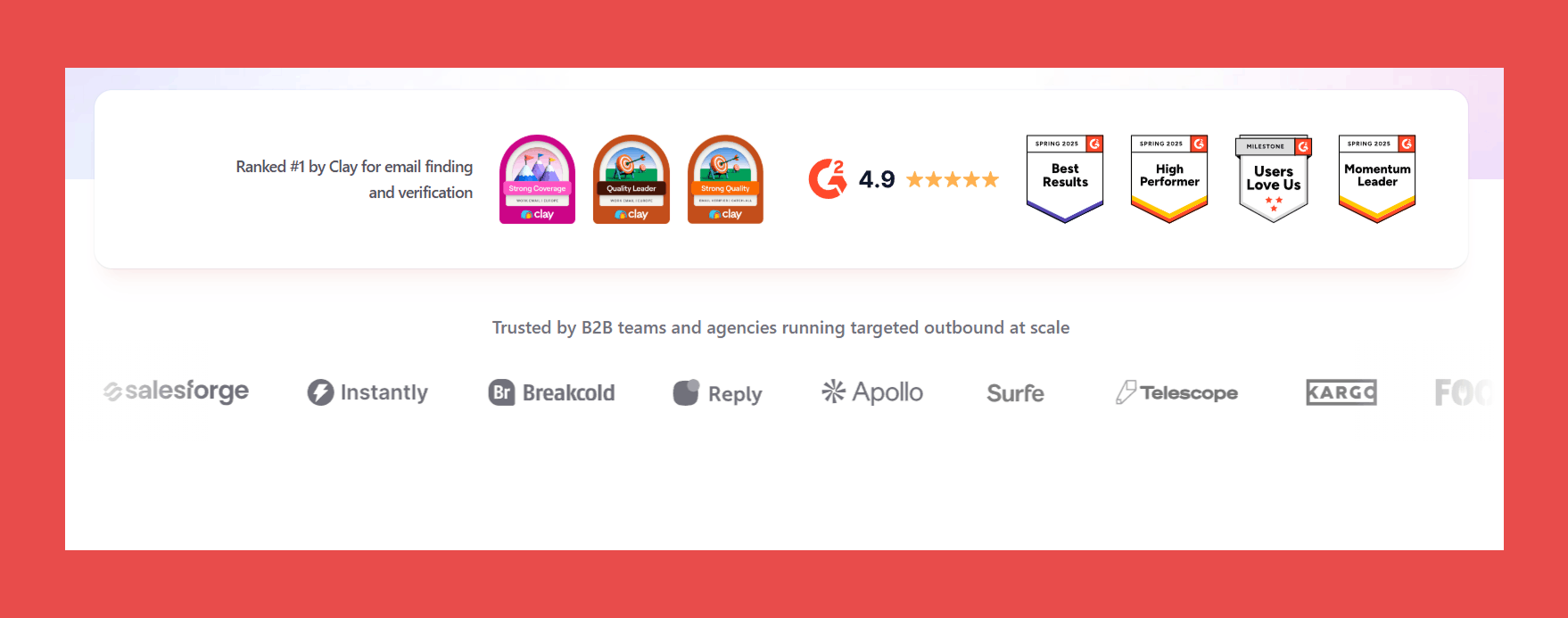
- G2: 4.9/5 (57)
- Capterra: 4.9/5 (7)
Pros:
- Signal monitoring and verified contact enrichment in one place. No stitching tools together.
- Industry-leading verification accuracy backed by a sub-5% bounce rate guarantee and a refund policy to match.
- Proprietary catch-all detection that goes beyond the "risky" flag most competitors hide behind, returning a definitive deliverable verdict instead.
Cons:
- Newer to the signal monitoring space compared to established enterprise platforms.
- No native sequencing or outreach features, so it works best paired with a dedicated sending tool.
Pricing:
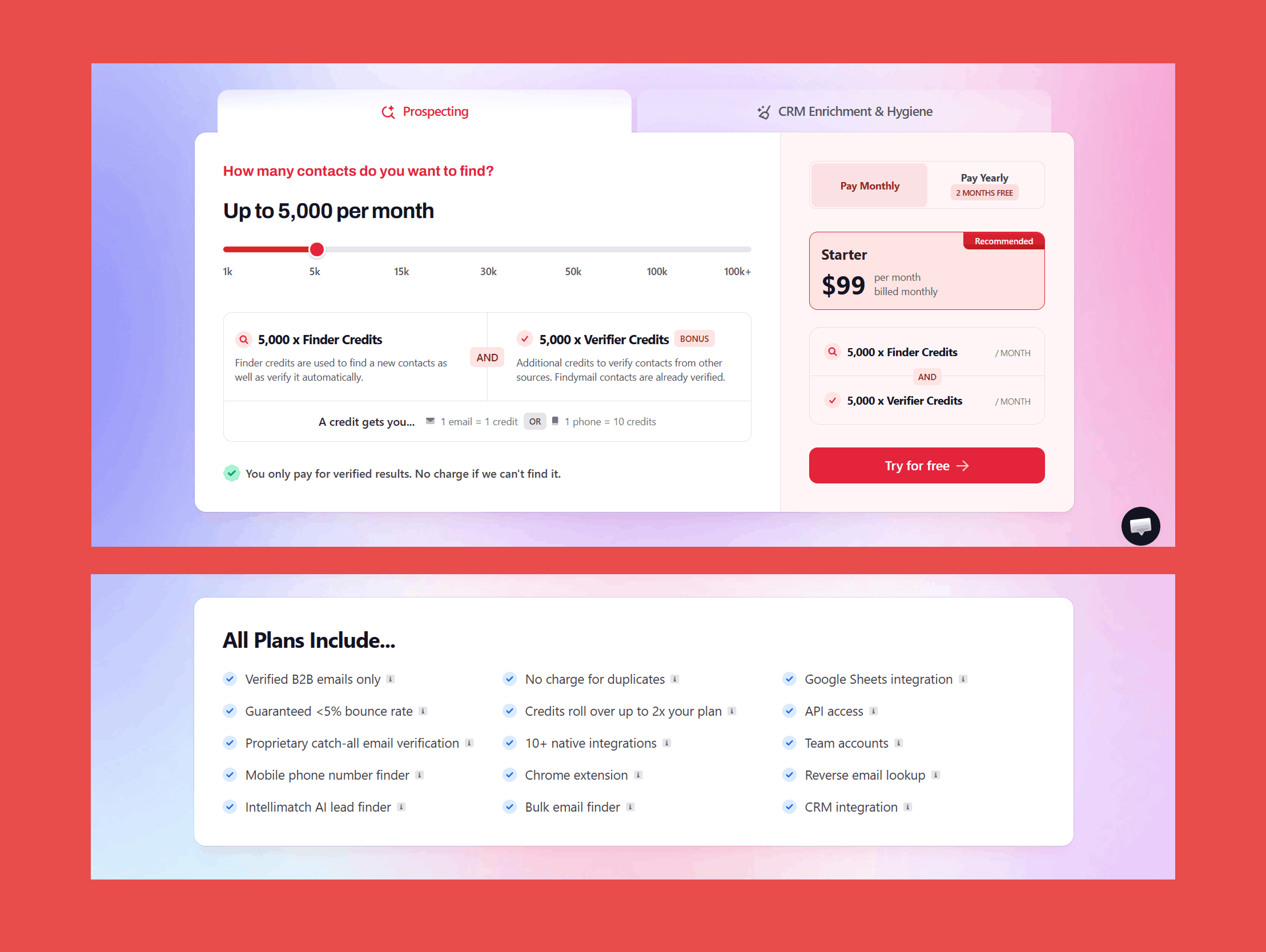
Findymail works on a credit-based pricing model where credit usage varies by signal type: New Hire and Job Title Change cost 1 credit per signal. Keyword Mention and Topic Engagement cost 1 to 3 credits depending on ICP filters applied. Here’s a quick breakdown of each plan:
- Basic: $49/mo – 1,000 x Finder Credits + 1,000 x Verifier Credits/mo
- Starter: $99/mo – 5,000 x Finder Credits + 5,000 x Verifier Credits/mo
- Business: $249/mo – 15,000 x Finder Credits + 15,000 x Verifier Credits/mo
- Business Plus: $399/mo – 30,000 x Finder Credits + 30,000 x Verifier Credits/mo
- Scale 50K: $549/mo – 50,000 x Finder Credits + 50,000 x Verifier Credits/mo
- Scale 100K: $849/mo – 100,000 x Finder Credits + 100,000 x Verifier Credits/mo
- Enterprise: Custom – Custom Finder Credits + Custom Verifier Credits/mo
Every plan includes finder and verifier credits, real-time verification, and a sub-5% bounce rate guarantee. Signal monitoring and verified contact data in one place, starting at $49/mo.
2. 6sense → Best for: Predictive AI scoring and full-funnel ABM execution
Overview:
Most intent tools tell you who's researching, 6sense tells you where they are in the buying process. By combining third-party intent signals with predictive AI scoring, it surfaces accounts by buying stage rather than raw behaviour alone. Built for revenue teams running sophisticated, multi-channel ABM programmes where timing and personalisation need to work together at scale.
Key Features:
- Signalverse™: Real-time intent signals, web deanonymisation, and enriched company and contact data in one feed.
- 6AI Predictive Scoring: AI models that process signal data into buying stage predictions, not just intent flags.
- Multi-Channel Orchestration: AI agents that run personalised campaigns across email, advertising, and omnichannel workflows based on ICP and buying stage.
- Sales Intelligence: Account and buying group insights that help reps prioritise and personalise outreach with precision.
Ratings:
- G2: 4.1/5 (2,372)
- Capterra: 4.6/5 (30)
Pros:
- Identifying duplicate accounts that share the same domain is straightforward, keeping your data clean and your targeting precise.
- Sales Intelligence gives clear visibility into buyer behaviour and account insights, making it easier to align sales and marketing around opportunities most likely to convert.
Cons:
- Enterprise pricing makes it inaccessible for most smaller teams.
- Intent signals aren't always precise, and contact data can be incomplete or outdated, a common limitation across platforms at this level.
- The LinkedIn Sales Navigator plugin has been reported as non-functional for over a year.
Pricing:
- Not publicly available. You'll need to contact their sales team for a quote.
3. Bombora → Best for: Enterprise teams running sophisticated ABM with third-party intent data
Overview:
Bombora pioneered the third-party intent data category and remains the gold standard for account-level research signals. It pulls content consumption data from a co-op network of 5,000+ B2B publishers and surfaces accounts that are researching specific topics at rates well above their historical baseline. If a target account is quietly evaluating solutions in your category, Bombora is one of the most reliable ways to find out, though the price tag reflects that pedigree.
Key Features:
- Company Surge®: Identifies accounts actively researching your category and competitors', compatible across nearly all tech stacks.
- Data Co-op: 5,000+ premium B2B publishers, with 86% of co-op data shared exclusively with Bombora.
- Topic Tracking: Monitor intent across 12,000+ industry-specific topics.
- Audience Builder: Segment and prioritise accounts by surge strength, vertical, and company size.
- Consent-Driven Data: GDPR and CCPA compliant.
Ratings:
- G2: 4.4/5 (162)
- Capterra: 4.5/5 (2)
Pros:
- One of the highest-quality third-party intent datasets available.
- Consent-based data collection, not scraped or bidstream.
- Strong fit for sophisticated ABM campaigns.
Cons:
- Enterprise pricing puts it out of reach for most SMB and mid-market teams.
- Requires existing ABM infrastructure to get full value.
Pricing:
- Not publicly available. You'll need to contact their sales team for a quote.
4. Clay → Best for: RevOps and technical teams that want fully custom signal workflows
Overview:
Clay sits in a category of its own. Rather than offering a fixed set of signals, it gives you the infrastructure to build whatever signal workflow your GTM motion requires — pulling from 100+ data sources including LinkedIn activity, hiring trends, news mentions, and tech adoption data. The ceiling is essentially unlimited, but so is the complexity. Teams that invest in learning Clay properly get a serious competitive advantage. Teams that don't end up with expensive spreadsheets.
Worth noting: Clay ranks Findymail as its #1 email enrichment source.
Key Features:
- Claygent: An AI research agent that reads websites, completes forms, and surfaces insights traditional databases miss.
- Data Enrichment: 150+ data sources for company size, tech stack, social data, and verified contact information (including job postings, LinkedIn activity, funding events, and news mentions).
- Custom Waterfall Enrichment: Choose which providers run first to balance coverage, cost, and data quality.
- Sales Outreach Tools: Automated emails, LinkedIn touches, and AI-powered personalisation built directly into enrichment workflows.
- CRM & Workflow Integrations: Native syncs with HubSpot, Salesforce, Zapier, and more.
Ratings:
- G2: 4.7/5 (217)
- Capterra: N/A
Pros:
- Findymail is one of Clay’s premium data providers, giving teams access to highly verified contact data within workflows.
- Built-in sequencing lets you run personalized outreach directly from enriched tables.
- Powerful AI automation tools (like Sculptor and Claygent Builder) allow users to describe workflows in plain English and have Clay build them.
Cons:
- Steep learning curve, especially for beginners.
- Pricing can be high for smaller teams.
- Credit usage adds up quickly if workflows aren’t optimized.
Pricing:
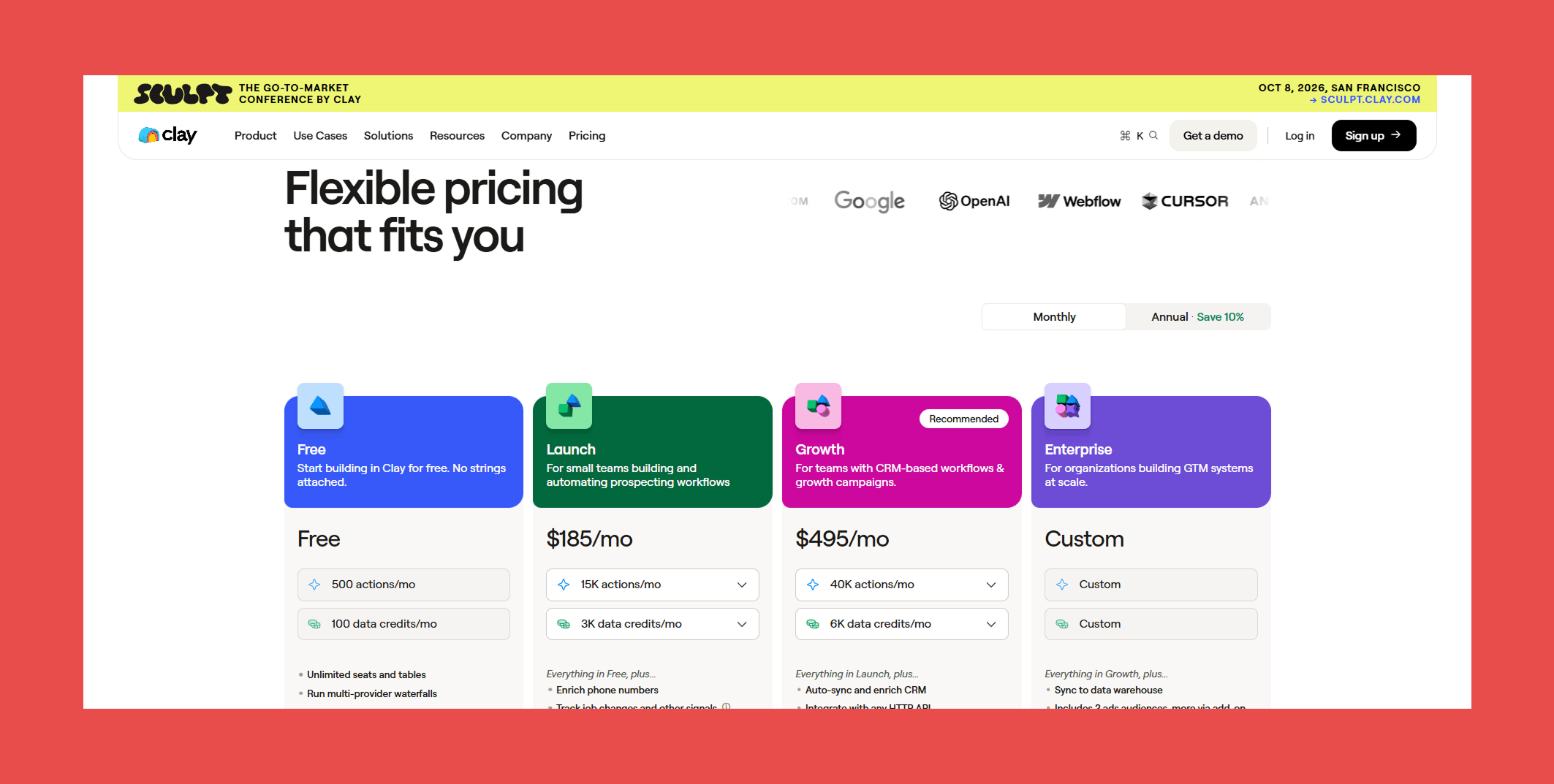
- Free: 14-day trial – 500 actions/month + 100 data credits/mo
- Launch: $185/mo – Starts at 15,000 actions/mo
- Growth: $495/mo – Starts at 40,000 actions/mo
- Enterprise: Custom – Custom actions
5. Lead Onion → Best for: All-in-One Intent and Outreach
Overview:
Lead Onion is built for teams that want to go from signal to booked meeting without switching between platforms. It pulls intent data from 20+ sources, matches it to verified contacts, and automatically routes leads into the right outreach cadences the moment a signal fires. A practical choice for mid-market teams that want solid coverage and built-in activation, without the complexity of an enterprise ABM suite.
Key Features:
- Multi-Source Intent Data: Signals aggregated from 20+ data sources into one unified view.
- Person-Based Intent: Identifies the actual individuals doing the research, not just the company, with full contact records attached.
- Website Visitor Identification: Reveals visiting companies and key contacts in real time.
- Leadflows: Automatically routes verified contacts into the right cadences and workflows the moment intent is detected.
Ratings:
- G2: 4.2/5 (31)
- Capterra: N/A
Pros:
- Intent data, verified contacts, and outreach automation in one place.
- 20+ intent sources gives you broader signal coverage than most single-source tools.
- Strong customer support, with regular check-ins and hands-on onboarding.
Cons:
- Some users report data accuracy inconsistencies, particularly with firmographic filters returning out-of-scope results.
- The platform terminology and navigation can feel unintuitive, especially for new users.
- Workflow prioritisation logic is limited, which can become a blocker for teams with more complex cadence requirements.
Pricing:
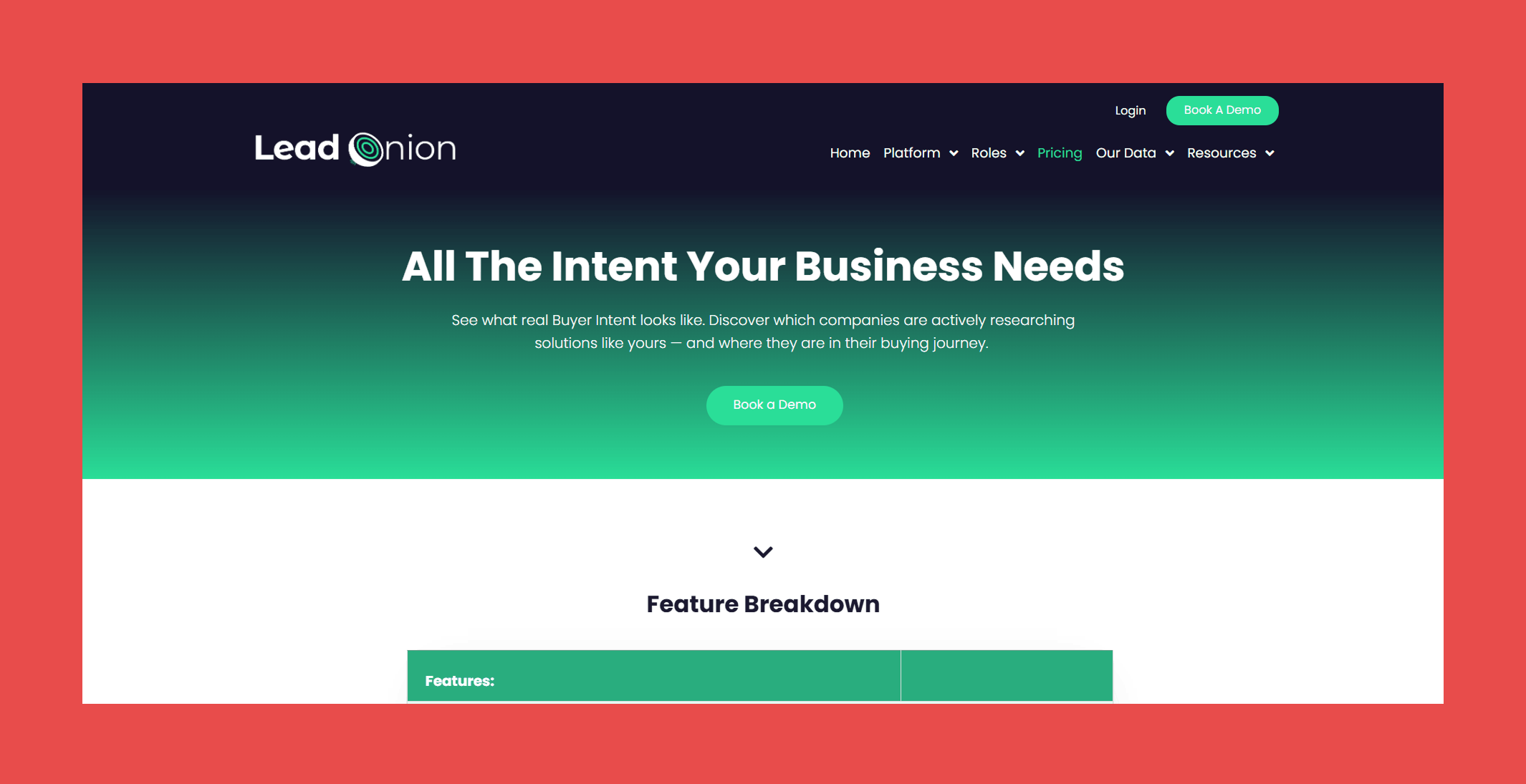
- Not publicly available. Contact Lead Onion for a custom quote.
6. Demandbase → Best for: Account-Based Marketing at Scale
Overview:
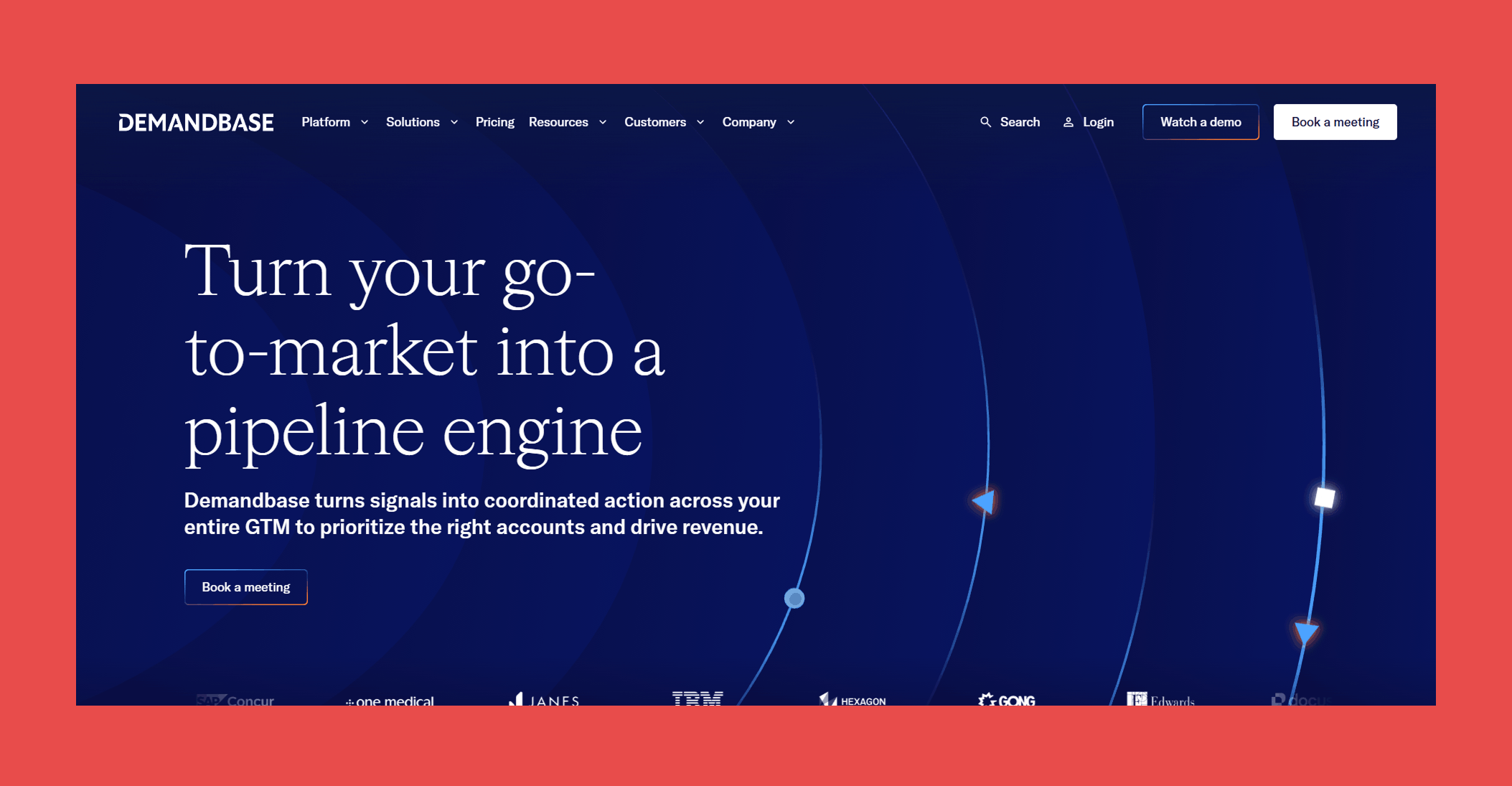
Demandbase is the enterprise standard for ABM, and it's priced accordingly. It brings together first-party engagement data, third-party intent signals, a native B2B DSP, AI agents, and sales intelligence into one tightly integrated system. For organisations running complex, multi-channel ABM programmes with the ops team to support it, there's very little it can't do. For everyone else, it's probably more platform than you need, and you'll spend weeks in a sales process just to find out what it costs.
Key Features:
- Demandbase Intent: First-party and third-party intent signals combined to identify accounts actively researching your category, included across all plans.
- Pipeline Predict AI: Conversion likelihood scoring to keep teams focused on the opportunities most likely to close.
- Agentbase: A connected system of AI agents (launched March 2025) that automates account intelligence, campaign optimisation, and engagement monitoring.
- B2B DSP: Run account-targeted display, social, and video ads directly from the platform.
- Sales Intelligence: Buying group insights and account-level data to help reps prioritise and personalise at scale.
Ratings:
- G2: 4.4/5 (1,938)
- Capterra: N/A
Pros:
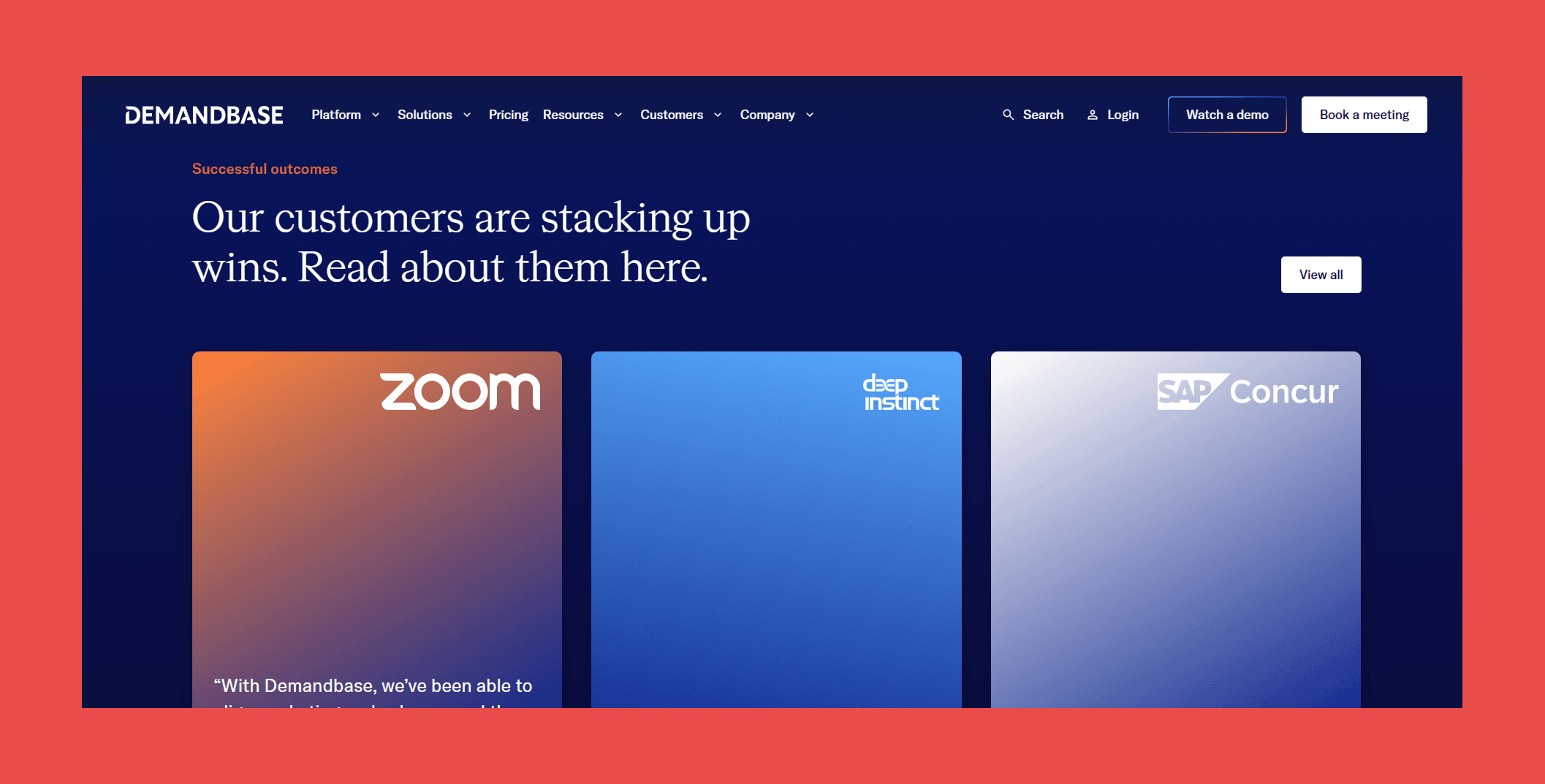
- One of the strongest tools for intent data, consistently praised by reviewers for quality and accuracy.
- A true full-stack ABM platform, covering ads, intelligence, and orchestration in one place.
- Dedicated Customer Success Managers receive consistently high marks.
Cons:
- Pricing is completely opaque. Expect a multi-week sales process before you even know what you'll pay.
- Steep learning curve. Multiple reviewers report it took months before the platform was running at full capacity.
- Several features that appear included are actually gated behind additional modules, pushing total costs well above the initial quote.
Pricing:
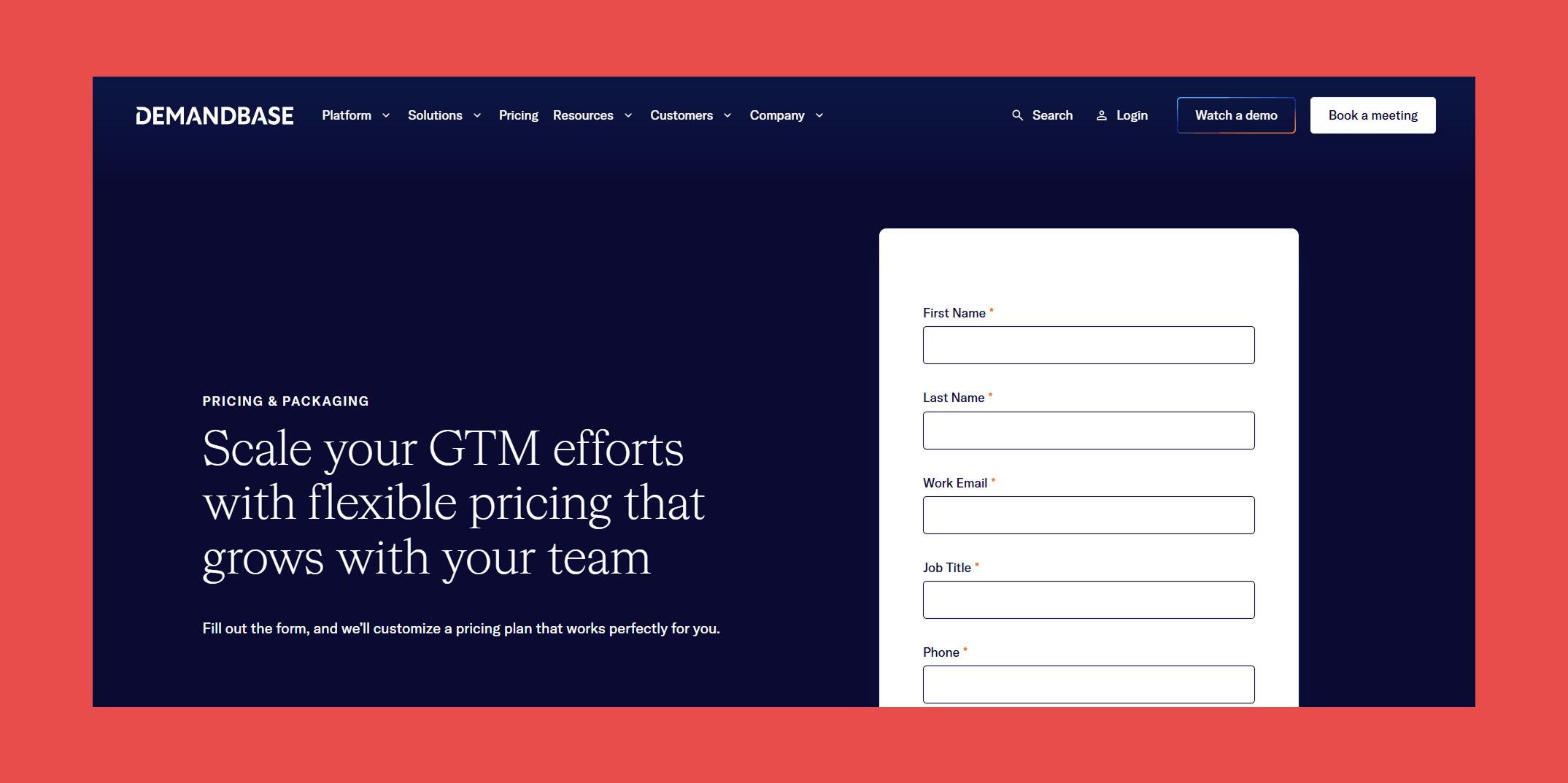
- Not publicly available. Fill out a form and contact sales to get a quote.
7. Apollo.io → Best for: SMBs and early-stage teams wanting an affordable all-in-one platform
Overview:
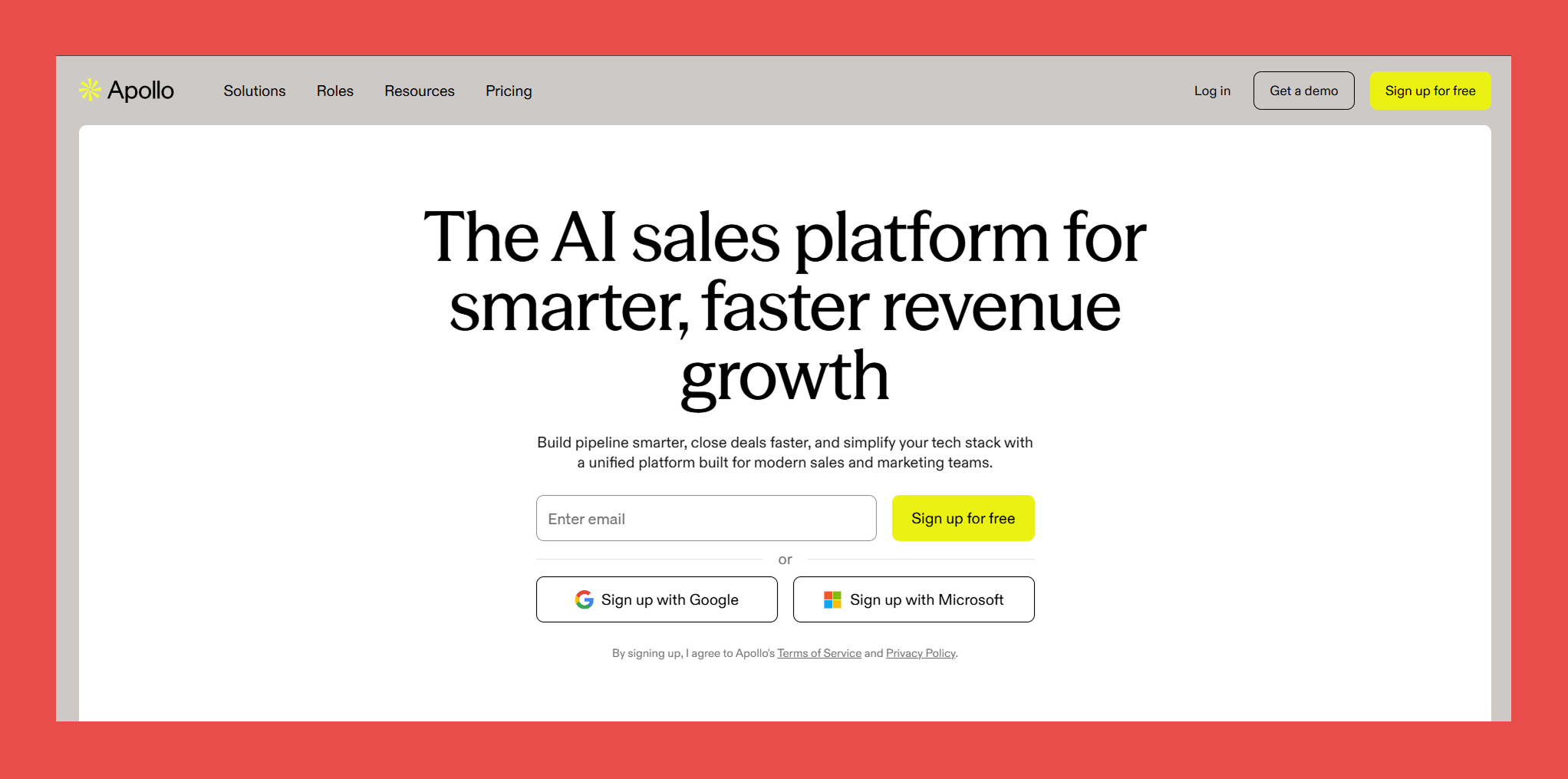
Apollo is where most outbound teams start, and for good reason. It packages a 270M+ contact database, email sequencing, a built-in dialer, and basic intent signals into one platform at a price point that's hard to argue with. It won't match the signal depth of dedicated intent platforms, but for teams who want a solid all-in-one outbound motion without the complexity or cost of an enterprise stack, Apollo gets the job done. Just set realistic expectations on data accuracy outside of North America.
Key Features:
- Prospecting Database: 270M+ contacts with 65+ search filters including firmographics, technographics, intent data, job changes, funding rounds, and tech stack changes.
- AI Sales Tools: Lead scoring, email writing assistant, call summaries, and account research agents.
- Sequences: Multi-channel outreach across email, calls, and LinkedIn built directly into the platform.
Ratings:
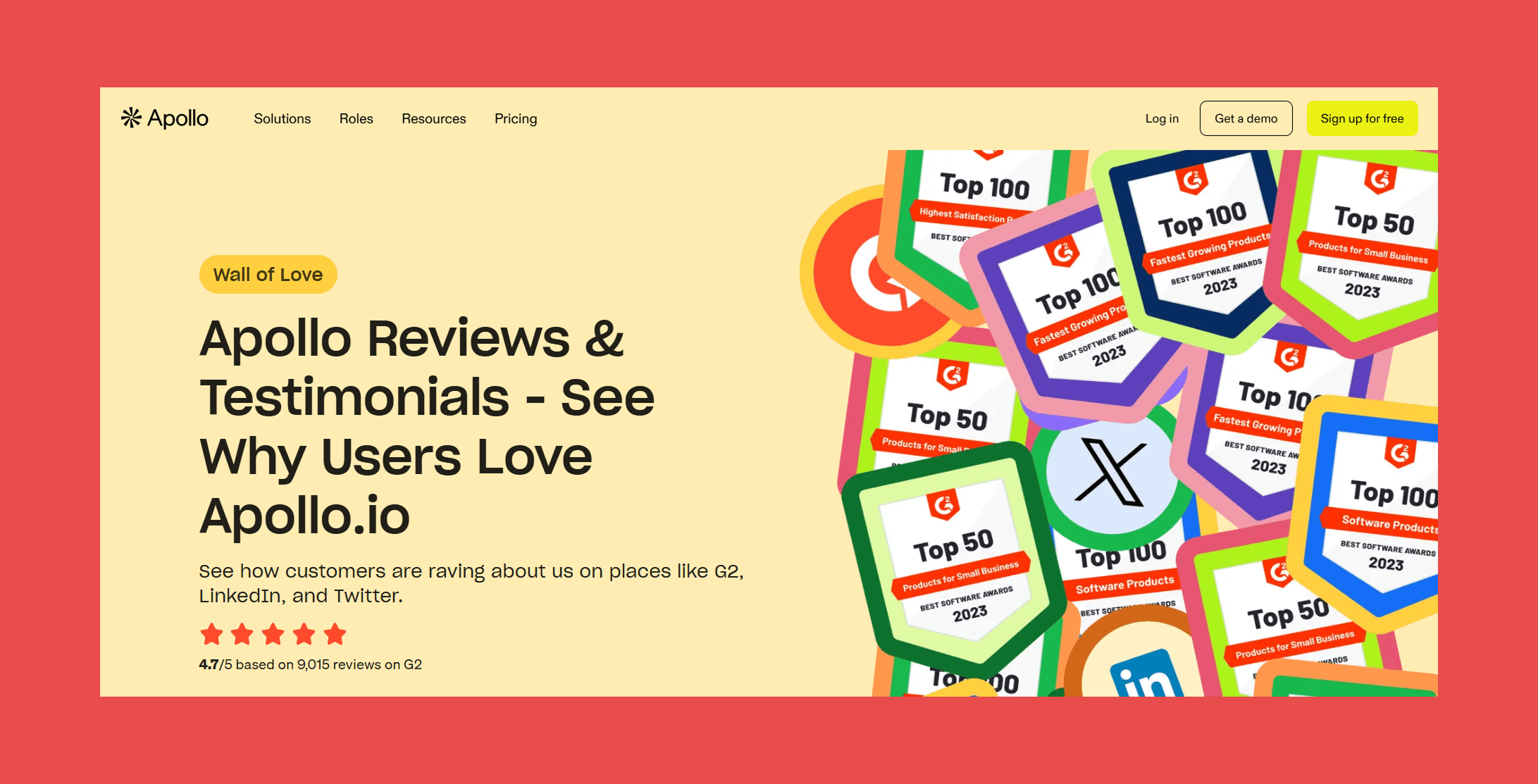
- G2: 4.7/5 (9,634)
- Capterra: 4.5/5 (391)
Pros:
- Transparent pricing and a genuinely useful free plan make it the most accessible option on this list.
- Database, sequencer, dialer, and AI tools in one platform.
- Clean, intuitive UI with strong LinkedIn integration.
Cons:
- Data accuracy can be hit or miss, particularly for phone numbers and contacts outside North American markets.
- Customer support response times have been flagged repeatedly by users across G2 and Capterra.
- Intent signal depth is limited compared to dedicated signal platforms.
Pricing:
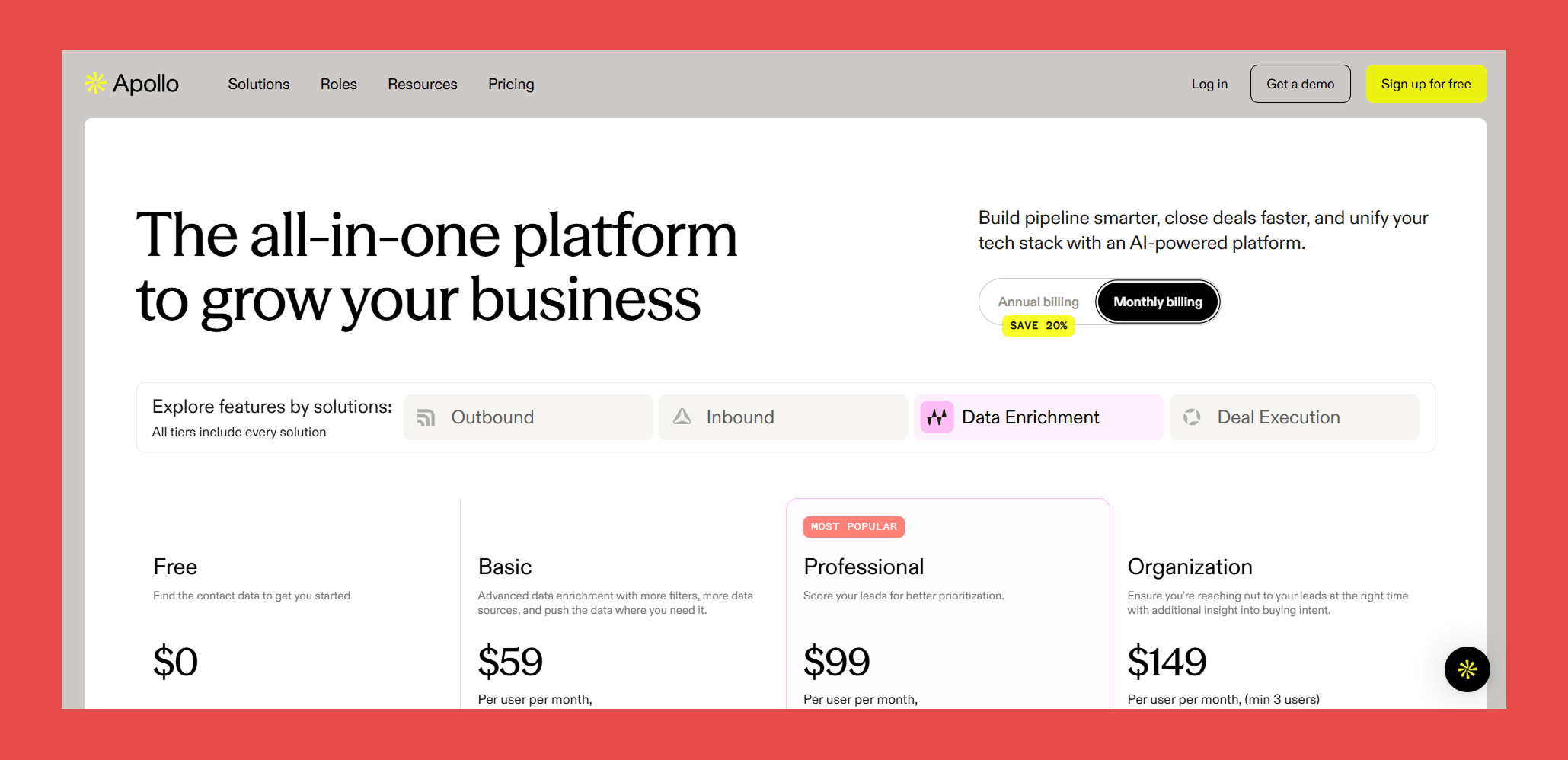
- Free: $0 – 75 credits/user/mo
- Basic: $59/user/mo – 2,500 credits/user/mo
- Professional: $99/user/mo – 4,000 credits/user/mo
- Organization: $149/user/mo – 6,000 credits/user/mo
Final Thoughts
The era of spray-and-pray outreach is over. Today's buyers are more informed, more independent, and harder to reach than ever, and the teams still relying on static lists and generic cadences are feeling it in their reply rates.
Signal-based selling isn't a trend. It's the new baseline. The teams winning pipeline in 2026 aren't just reaching the right accounts, they're reaching them at exactly the right moment, with exactly the right message. That's the edge that signals give you.
Signals closes the loop, now you know who to contact, why they're relevant, and when the window is open. All in one place, starting at $49/month.
The buying window is short. Don't let it pass.

Valentin
Valentin Wallyn is the founder and CEO of Findymail, a SaaS platform he launched to help B2B teams discover accurate email and contact data and automate data enrichment at scale. With an IT background, Valentin combines a technical mindset with hands-on experience in outreach and growth. His work centers on improving data quality and prospecting efficiency, drawing on years of entrepreneurial experience and a deep understanding of what makes outreach campaigns succeed.