AI Lead Finder
 Email Finder
 Email Verifier
 Phone Finder
 Intent Signals
 CRM Enrichment/Cleaning
 API
API

Building lead generation tools, CRM enrichment pipelines, or sales automation products means you eventually need access to professional email addresses. At volume. Reliably. Without torpedoing your sender reputation on unverified domains.
The problem: every email finder API claims to be "accurate" and "developer-friendly." Most of them are neither. Some return confident guesses with no SMTP verification. Others have great coverage but documentation that reads like it was written by the product manager's intern. A few are affordable until you actually scale, at which point the credit math gets ugly fast.
If you're embedding email enrichment into your stack, here's what you actually need to know.
Findymail verifies every email before it returns a result, so what you get back is what actually lands. Pay only when a verified email is found.
Top Picks:
1. Findymail
2. Dropcontact
3. Icypeas
4. FullEnrich
5. Anymail Finder
6. LeadMagic
7. Clearout
8. Skrapp
What Is an Email Finder API?
An email finder API takes a person's name and company domain, then returns a professional email address. You send a POST request; you get an email back (or you don't). That's the core transaction.
In practice, developers use them for CRM enrichment (filling gaps in contact records), sales engagement platforms (auto-populating prospect data), recruiting software (reaching candidates directly), GTM automation (triggering outreach when someone hits a signal), and lead generation products (building enriched lists at scale).
The distinction worth understanding early: finding an email and verifying an email are two different operations. Finding means locating a probable address. Verification means confirming it's real, active, and won't bounce. Most APIs do one well. Fewer do both in a single workflow. That gap is where sender reputations go to die.
What to Look For in an Email Finder API
Accuracy and Coverage
Accuracy isn't just "does it return an email." It's "does that email actually deliver." B2B contact data decays at roughly 30% per year; a provider refreshing its database quarterly is already selling stale records.
The two key metrics: find rate (how many of your lookups return a result) and hard bounce rate on live sends (what percentage of those results actually work). A 90% find rate with a 20% bounce rate is worse than a 60% find rate with a 1% bounce rate. The math on domain reputation damage favors accuracy over coverage every time.
For any API you evaluate, ask whether emails are verified before being returned, or whether verification is a separate step you have to trigger manually.
Built-In Verification
SMTP verification checks whether the mail server will accept delivery for a given address. Catch-all detection identifies domains configured to accept any email sent to them, a meaningful edge case, because an email returned from a catch-all domain looks valid but may never reach anyone real.
The best APIs handle both at query time, so you're not managing a separate verification workflow. Getting a single verified result back is far cleaner architecturally than getting a raw result and then firing off a second API call to check if it's real.
Documentation and Developer Experience
Good API documentation matters more than most vendors admit. If you can't find example requests, understand the error codes, or figure out how auth works in under 10 minutes, that's a real integration cost.
What to check: REST design consistency, OpenAPI spec availability (so you can generate client code or import into Postman immediately), authentication clarity, example curl requests, error handling docs, and whether there's webhook support for async workflows.
Performance and Scalability
Rate limits vary wildly. Some APIs gate you at 10 requests per second; others handle hundreds of concurrent requests without complaint. For high-volume products, this becomes the determining factor.
Also worth examining: whether the API supports bulk lookups natively, whether it has async processing for large batches, and what the SLA looks like on uptime. A finder API that goes down during a batch job is a product bug.
Pricing Model
Two main models: pay-per-request (you pay whether or not an email is found) and pay-per-found (you only pay when you get a result). For most developer use cases, pay-per-found is significantly better economics, especially when find rates vary by industry or company size.
Credit-based pricing with monthly rollovers is common. Watch for hidden costs: some providers charge separately for verification, which doubles your effective cost per contact.
Best Email Finder APIs for Developers in 2026
1. Findymail API
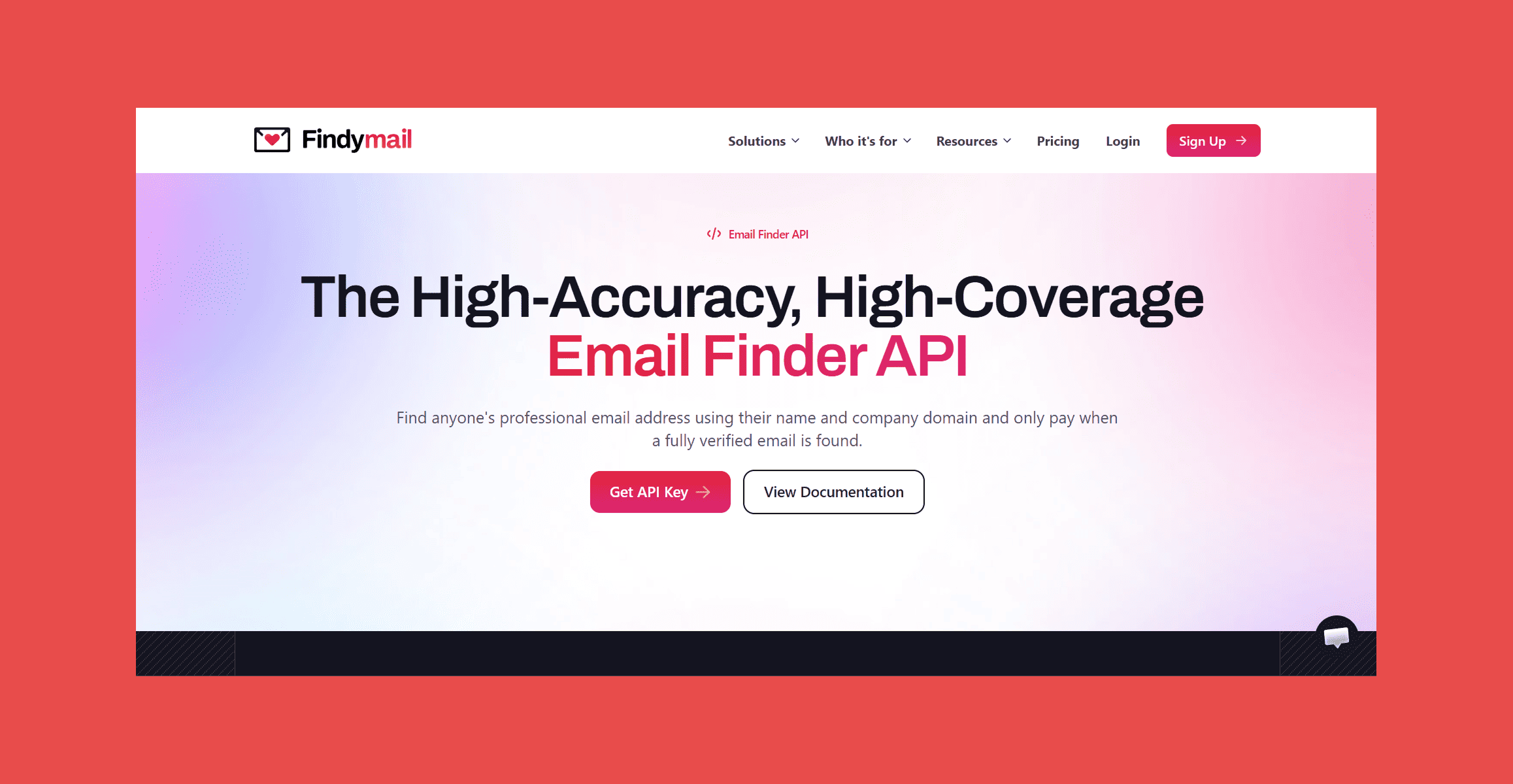
Findymail's main argument is simple: every email it returns is verified before it reaches you. You don't get a raw address and a verification status field. You get a confirmed deliverable address, or nothing. And critically, you only pay when it finds something.
On the documentation side, Findymail provides an OpenAPI spec, which means you can import directly into Postman or generate typed clients. Error responses are consistent. Rate limits support high concurrency for parallel processing, which is the real unlock for bulk enrichment workflows.
Best for: SaaS products building enrichment into their core offering, sales tools, CRM platforms, and any developer who wants one API call that returns a working email address.
Pros:
- Verification built directly into the finder workflow; no second API call required.
- OpenAPI documentation; fast integration.
- Pay-only-when-found pricing model.
- High concurrency limits for parallel processing.
Cons:
- Focused on contact enrichment; not a broad contact database with phone numbers, LinkedIn profiles, etc. out of the box.
Pricing: Plans start at $49/month for 1,000 finder credits and 1,000 verifier credits. Pay-per-found model, credits only deducted on successful lookups. Enterprise is custom.
Findymail's finder and verifier run in the same request, so your integration stays simple and your team stops chasing down a separate validation pipeline.
2. Dropcontact API
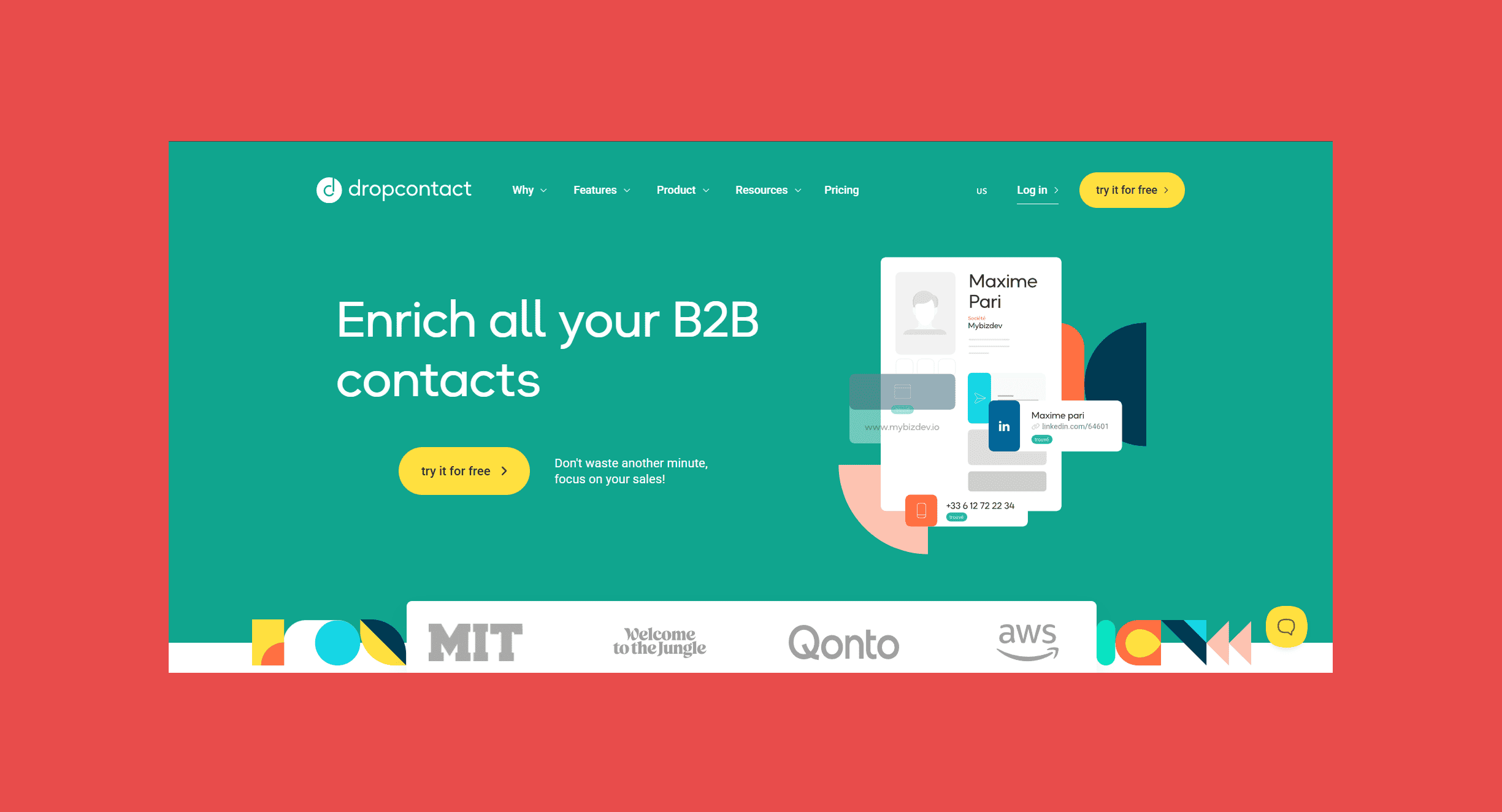
Dropcontact takes a different architectural approach than most tools on this list. Rather than querying a stored database, it generates and verifies email addresses in real time using a proprietary algorithm, no scraped or purchased data involved. The privacy-first design is the main argument for European teams where GDPR compliance is a hard requirement, not a checkbox.
One notable constraint: unused credits don't roll over. It's a use-it-or-lose-it monthly model, which is unusual in the category and worth factoring into your budget math.
Best for: European SaaS companies and teams where GDPR defensibility is a genuine procurement requirement, not just a nice-to-have.
Pros:
- GDPR-by-design architecture; no stored personal data.
- Built-in CRM enrichment (company data, LinkedIn, legal info) alongside email.
Cons:
- 60–70% overall match rate; lower than database-backed competitors
- Credits don't roll over monthly.
- API access requires Business tier (€79/mo) or above; lower tiers are UI-only.
Pricing: Entry plans from €24/month for 1,000 credits. Business plan at €79/month for 5,000 credits includes API access. Enterprise is custom.
3. Icypeas API
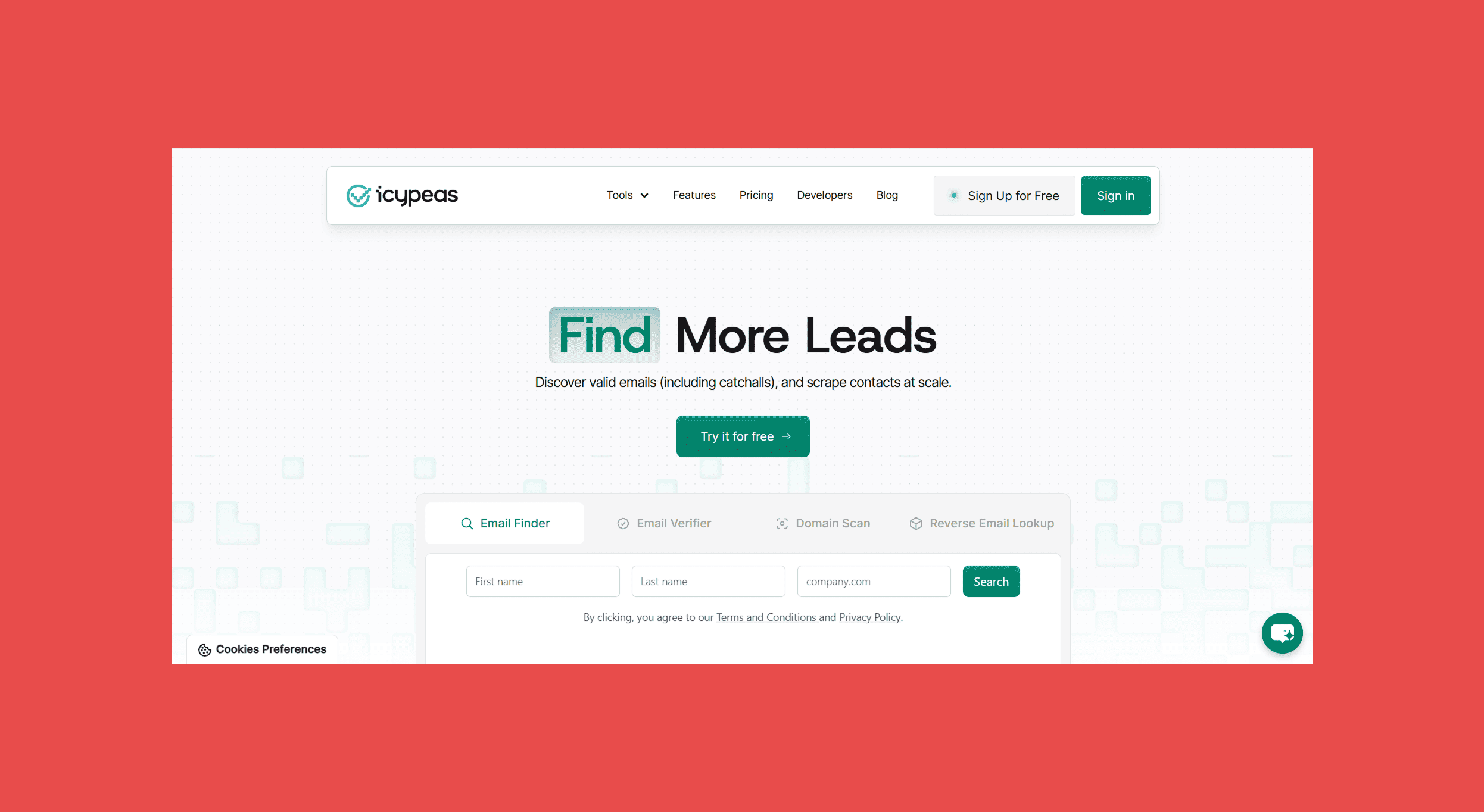
Icypeas positions itself as API-first enrichment infrastructure, and roughly 80% of its customers use the API rather than the web interface, which tells you something about who it's built for. The core differentiator is catch-all verification for Google Workspace and Microsoft 365 domains, which most email finders skip entirely. Flagging a catch-all domain as unverifiable and moving on is the safe choice; actually verifying whether the specific address is deliverable within that catch-all domain is the useful one.
Credits never expire and roll over indefinitely, even after cancellation, and you only pay when a result is successfully found and verified.
Best for: Enrichment pipelines and waterfall stacks where catch-all handling is a priority; developers who want low-cost, pay-per-verified API credits.
Pros:
- Catch-all verification for Google Workspace and Microsoft 365.
- Credits never expire; pay only for successful results.
- API available from entry tier ($19/mo).
Cons:
- ~31.6% enrichment rate in independent benchmarks; better as a supplementary source than a primary one.
- Individual lookups can be slow (1–5 minutes); bulk processing is faster.
Pricing: From $19/month (Basic, 1,000 credits). Credits roll over indefinitely. Pay-per-found model.
4. FullEnrich API
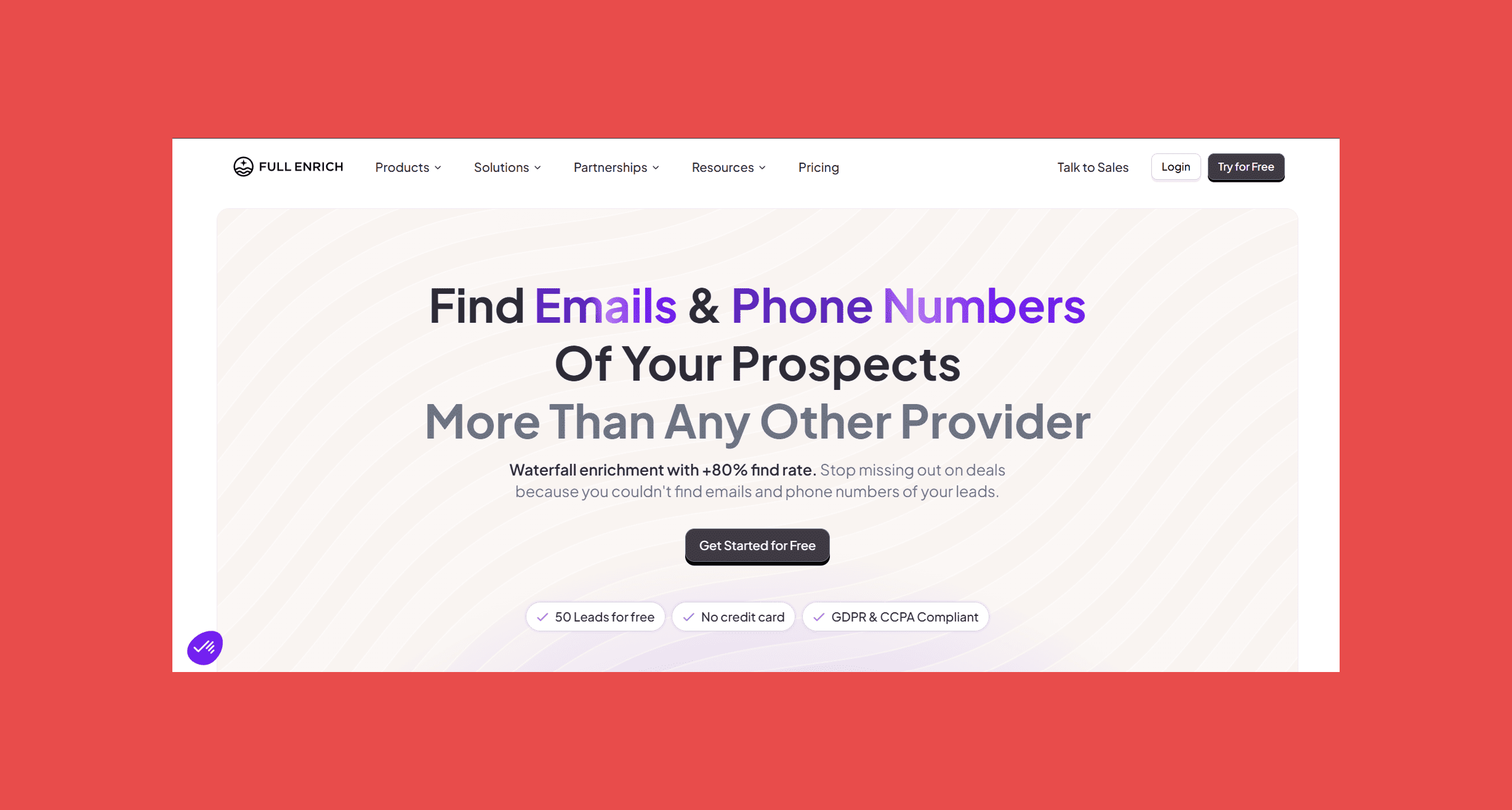
FullEnrich's bet is that no single data provider covers a full list, and the data supports it. Single-source tools typically match 40–60% of a given prospect list. FullEnrich's waterfall queries 15+ providers (including Apollo, Hunter, Dropcontact, Findymail, and others) in sequence per lookup, returning the first verified match. Independent benchmarks put the resulting find rate at 75–90% depending on the list, which is a meaningful jump over single-source alternatives.
Best for: Agencies, RevOps teams, and developers who need maximum coverage on enrichment lists and want a single API subscription rather than managing multiple provider integrations.
Pros:
- 15+ provider waterfall drives materially higher match rates than single-source tools.
- Pay-per-successful-match; no charge when the waterfall finds nothing.
- All team seats included; shared credit pool.
Cons:
- Phone lookups cost 10 credits each; budget math gets complicated fast at scale.
- No native Salesforce connector.
- Pricing can climb quickly for teams enriching 5,000+ contacts monthly.
Pricing: Starter at $29/month for 500 credits. Pro at $55/month for 1,000 credits. Annual billing saves ~20–30%. Custom enterprise pricing available.
5. Anymail Finder API
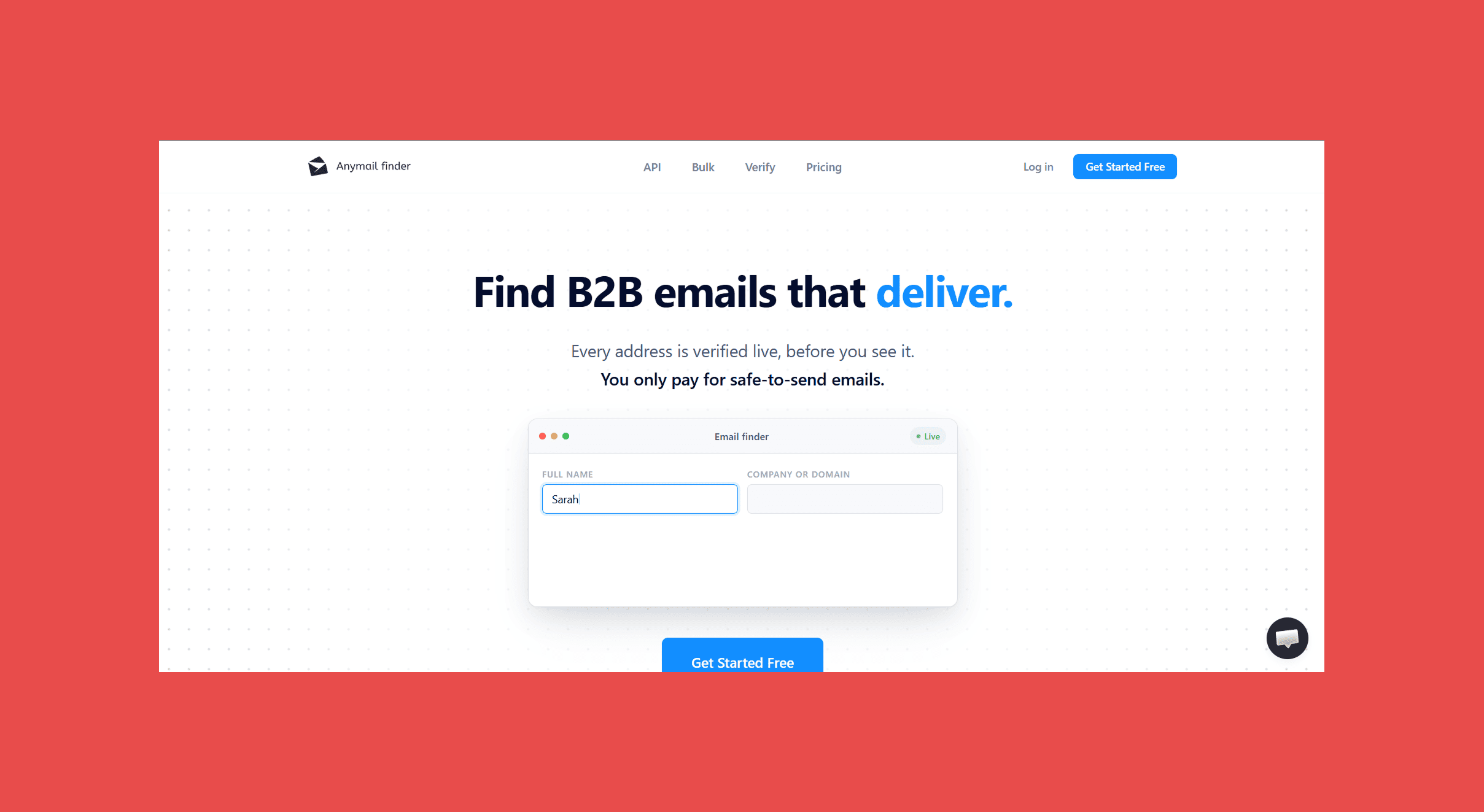
Anymail Finder has one of the cleanest pricing propositions in the category: you only pay for emails that pass verification. Unverified results, not-found results, and catch-all domains don't consume credits. The REST API is straightforward. Documentation covers real-time lookup, bulk CSV processing, and Zapier/Make integrations. Credits roll over month to month, up to 2x your plan size.
The trade-off is coverage: the smaller database and conservative verification means lower match rates than more aggressive finders. For teams where every credit counts and bounce rates matter more than find rates, that's an acceptable trade.
Best for: Accuracy-first teams on tighter budgets; developers who want the lowest possible effective cost per deliverable email.
Pros:
- Strictly pay-per-verified; no charges for bounces, catch-alls, or not-found results.
- Simple, clean API with good documentation.
- Credits roll over (up to 2x plan size).
Cons:
- Lower match rates than database-backed tools; conservative verification skips catch-all domains.
- No native CRM integrations, phone lookups, or enrichment beyond email.
Pricing: From $14/month for 50 verified emails. Scales to $149/month for 5,000 verified emails. Custom enterprise pricing available.
6. LeadMagic API
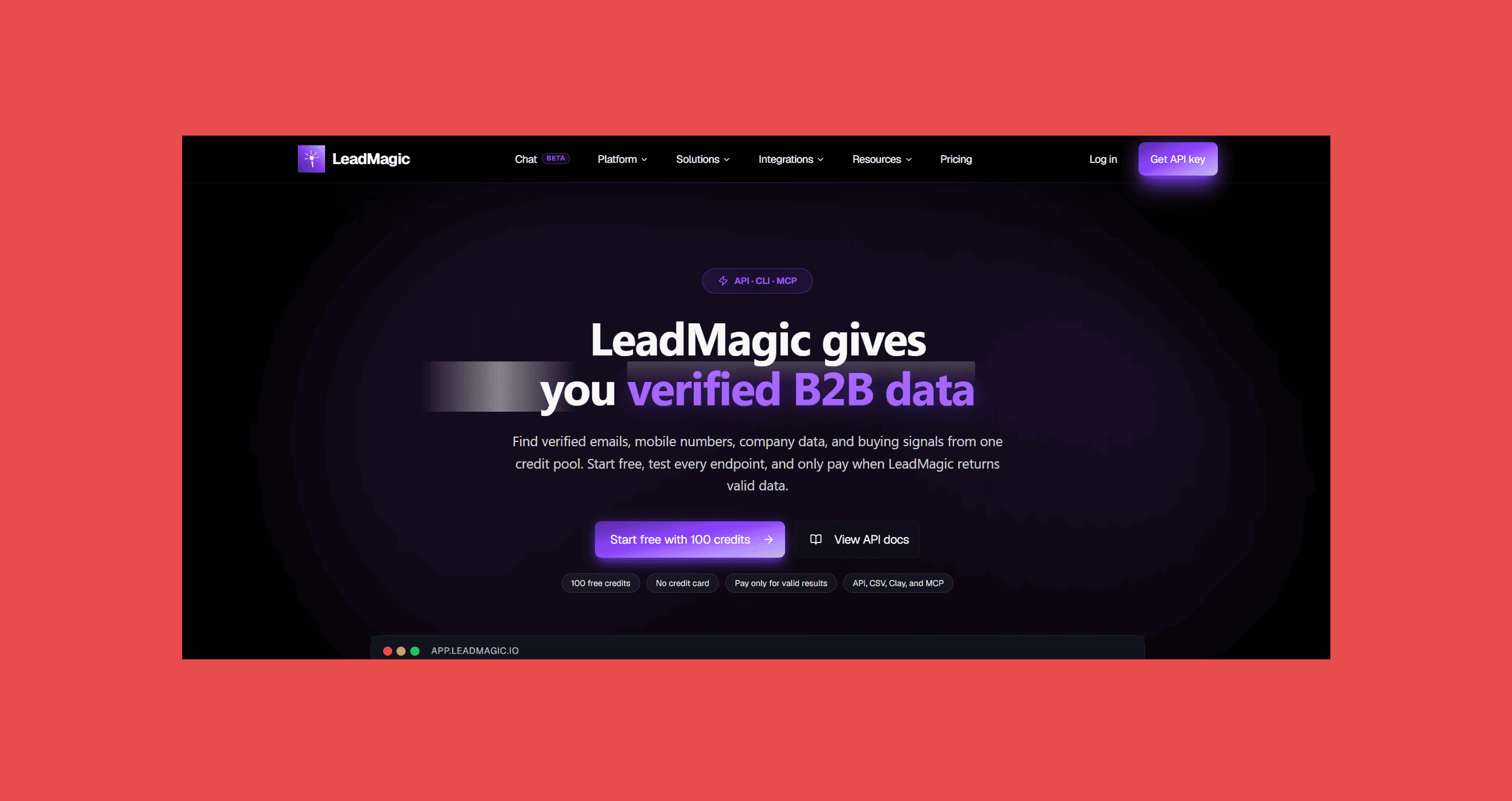
LeadMagic is built for GTM engineers and AI agent builders rather than SDRs clicking around a UI. Eighteen REST endpoints covering email, mobile, company data, LinkedIn profiles, and website visitor identification, all behind one API key. Response times average under 200ms. MCP support is available for teams building AI agents in Cursor or Claude.
The limitations are real: mobile number accuracy has mixed reviews, the review base on G2 is small (making signal harder to read), and the refund policy is explicitly no-refunds-ever. Test thoroughly on the free tier before committing to a paid plan.
Best for: RevOps teams and developers building enrichment pipelines that need multi-signal data (email + mobile + company) from a single API.
Pros:
- 18 endpoints covering email, mobile, company, and visitor identification in one API.
- Sub-200ms response times; MCP support for AI agent workflows.
- Pay-per-result; credits not consumed on failed lookups.
Cons:
- Mobile number accuracy has mixed independent reviews.
- Small G2 review base; harder to calibrate social proof.
- No refunds on any plan or credit purchase.
Pricing: Free tier with 100 credits. Paid plans from $49/month for 2,000 credits. Credits from $0.007 each at higher volume tiers.
7. Clearout API
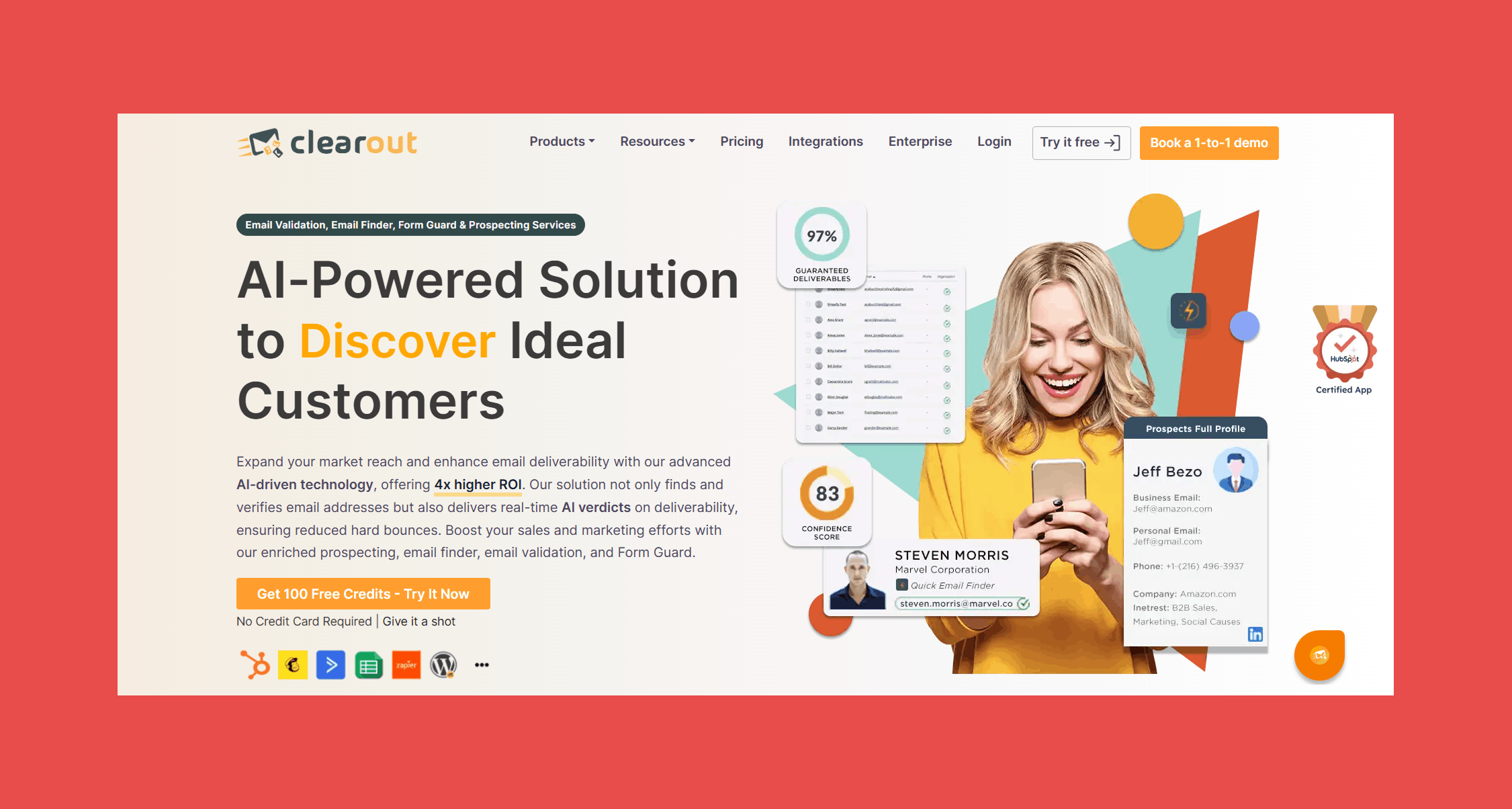
Clearout takes a verification-first approach. The API returns a confidence score alongside emails and supports both instant lookups and async queue processing, useful when you're running large batches and don't want to block on each individual request.
The OpenAPI spec is available, and the documentation covers error codes, timeout handling, and queue status endpoints in reasonable detail. Async processing specifically: you can send a request with, get a queue ID back, and poll for the result, which is the right architecture for high-volume batch enrichment.
Best for: Data quality-focused workflows; teams that need background processing for large verification jobs.
Pros:
- Strong verification-first approach.
- Async queue processing for large batches.
- OpenAPI documented.
Cons:
- Smaller ecosystem and community compared to top-tier options.
- Less coverage on the finding side relative to Findymail's Clay benchmark numbers.
Pricing: Free signup includes 100 credits. Beyond that, Clearout runs on prepaid credit packs (monthly, annual, or pay-as-you-go) rather than fixed tiers, with unused credits rolling over and never expiring.
8. Skrapp API
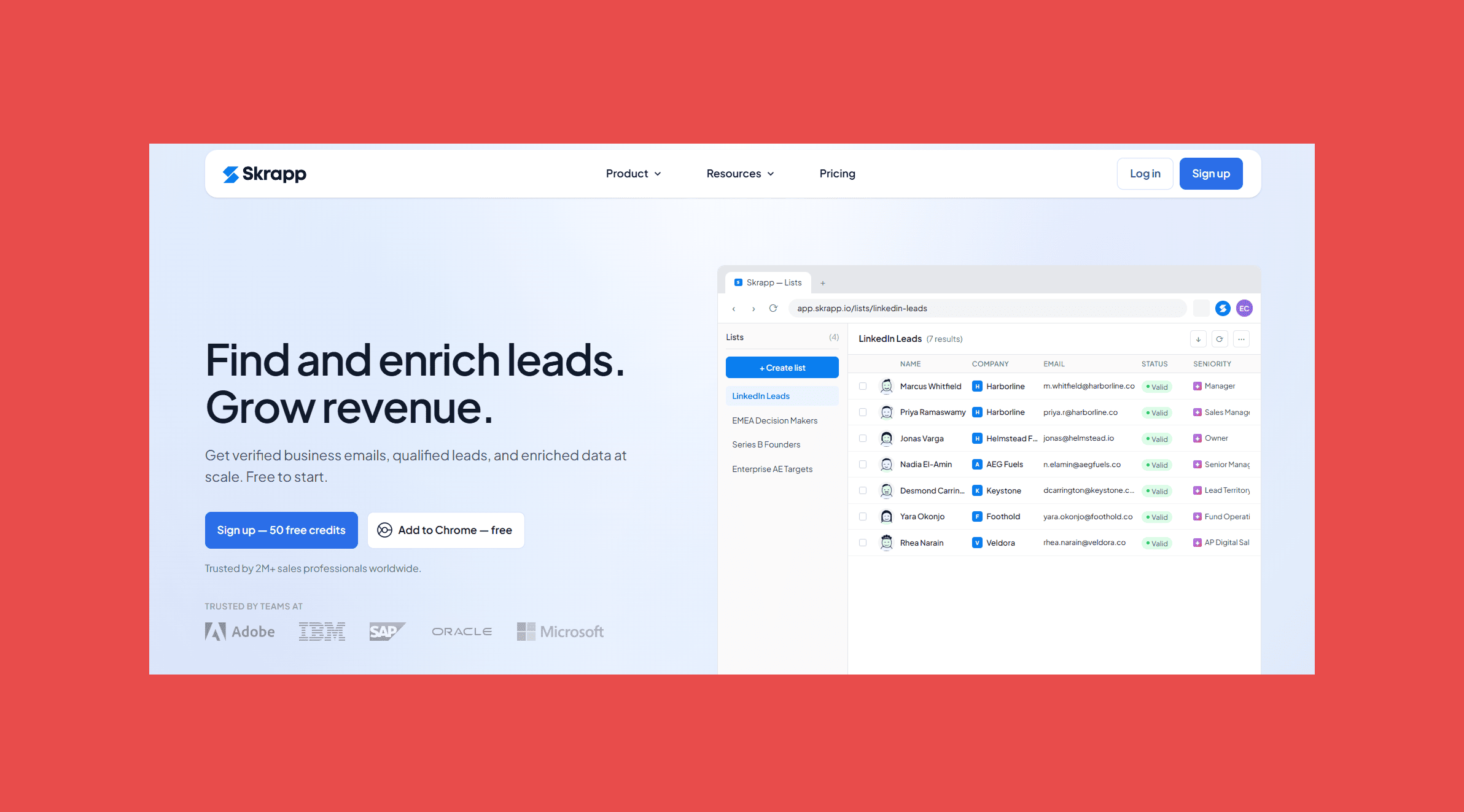
Skrapp is an email finder built around LinkedIn prospecting. The Chrome extension pulls email addresses directly from LinkedIn profiles and Sales Navigator searches; the API handles programmatic lookups by name and domain. It's a clean, focused tool that can find emails, verify them, and export the list. No outreach features, no CRM, no phone numbers.
The API documentation is functional, not exceptional. It covers authentication, the core finder endpoint, and bulk processing, without the OpenAPI spec or depth you'd get from Findymail or Hunter. API access is available from the Enterprise plan ($99/month and above).
Best for: Sales teams and marketers who primarily prospect through LinkedIn and want bulk email finding at a reasonable cost.
Pros:
- Strong LinkedIn integration via Chrome extension and Sales Navigator support.
- Credits roll over month to month.
- Affordable per-email cost at higher volume tiers.
Cons:
- API access gated to Enterprise plan ($99/month+); not available on entry tier.
- No phone numbers, outreach features, or enrichment beyond email.
- Email accuracy more variable on SMBs and less-indexed companies.
Pricing: Free plan with 50 credits. Professional 2K plan at $39/month. Enterprise 5K plan at $99/month (includes API access). Higher volume enterprise tiers up to $499/month.
Which Email Finder API Should You Use?
Building a SaaS product or sales tool? Findymail. Verification integrated at query time, top-ranked for coverage and data quality, pay-per-found pricing, clean REST API with OpenAPI docs. It's built for developers embedding enrichment into products.
Need maximum match rates on large lists? FullEnrich. The 15+ provider waterfall pushes find rates to 75–90% on most lists — well above what any single-source tool delivers.
Building for European markets where GDPR is a hard requirement? Dropcontact. Real-time algorithmic enrichment with no stored personal data is the only architecture that's genuinely GDPR-by-design.
Want the cheapest effective cost per verified email? Anymail Finder. Pay-per-verified-only from $14/month; no charges for catch-alls or not-found results.
Primarily prospecting through LinkedIn? Skrapp. The Chrome extension and Sales Navigator integration make it a natural fit for LinkedIn-first workflows, with rolling credit balances.
Final Thoughts
If you need one answer: Findymail. It combines finding and verification in a single API call, only charges when it succeeds, and has the independent benchmark data to back up its accuracy claims. For any developer building enrichment into a product, that combination is hard to argue against.
The underlying principle holds regardless of which you choose: don't trade accuracy for coverage. Sending to a bigger list of addresses that bounce costs you more than sending to a smaller list that delivers.
Findymail charges per verified result, not per attempt, with transparent credit pricing and no separate verification fees to budget around.
Frequently Asked Questions
What is the most accurate email finder API?
Findymail was independently ranked #1 for both coverage and data quality by Clay across 20+ providers. In live-send testing on 20,000 contacts, it posted a 1.1% hard bounce rate.
Can I verify emails through an API?
Yes. Most email finder APIs include some form of verification. The distinction is whether verification runs at query time (Findymail, Clearout) or as a separate endpoint you trigger manually. Integrated verification is architecturally simpler.
What's the difference between email finder and email verification APIs?
Email finder APIs take a name and domain and return a probable email address. Email verification APIs take an email address and confirm whether it's deliverable. The best email finder APIs do both in a single operation.
Are email finder APIs GDPR compliant?
Findymail is explicitly GDPR compliant with EU-based data processing available. If you're building for European markets, verify the specific data processing agreements and storage locations before integrating.
Which email finder API is best for SaaS products?
Findymail. The combination of integrated verification, a pay-per-found pricing model, and OpenAPI documentation makes it the most practical choice for a SaaS product that needs to embed email enrichment reliably.

Valentin
Valentin Wallyn is the founder and CEO of Findymail, a SaaS platform he launched to help B2B teams discover accurate email and contact data and automate data enrichment at scale. With an IT background, Valentin combines a technical mindset with hands-on experience in outreach and growth. His work centers on improving data quality and prospecting efficiency, drawing on years of entrepreneurial experience and a deep understanding of what makes outreach campaigns succeed.
![Cold Email: 15 Templates with 40%+ Response Rates [2026]](/blog/content/images/size/w300/2026/03/Cold-Email_-15-Templates-with-40---Response-Rates--2026-.jpg)